
Differences Between Ceiling C and U Profiles: Which One Goes Where?
Engineering and Application Fundamentals in Ceiling C and U Profile Distinction
In modern interior design, suspended ceiling systems offer many functional advantages, from concealing installations to acoustic regulation. To install these systems flawlessly, the roles of the parts forming the skeleton must be correctly defined. As HC Drywall Profile, the Ceiling C (TC) and Ceiling U (TU) profiles we produce complement each other like two halves of an apple, yet they play entirely different roles in the assembly hierarchy and static load distribution. In this content, we will examine which profile should be installed where in your suspended ceiling projects, the selection criteria, and application details from a professional perspective.
Definition and Framework Function of Ceiling U (TU) Profile
The Ceiling U profile is the element that is fixed to the wall and determines the boundaries, level, and plane of the suspended ceiling system. As the name suggests, it has a flat "U" form and is produced in a width that allows Ceiling C profiles to fit inside it. TU profiles, produced with precise measurements at HC Drywall Profile facilities, are the most critical reference points for leveling the ceiling. If the U profile is installed incorrectly or crookedly, the rest of the ceiling skeleton will follow this error, resulting in a wavy or distorted ceiling surface.
Mounting Position and Wall Connection Details of Ceiling U Profile
The location where Ceiling U profiles are installed is the wall surfaces that determine the finished height of the ceiling. They are mounted all around the walls of the room along the ceiling level determined by a laser meter or water level. The most important point to consider in the installation of this profile is the choice of wall plugs and screws suitable for the wall structure. According to HC Drywall Profile expertise, acoustic insulation tape must be applied to the back of the TU profile. This tape prevents the structural vibrations of the building from passing into the ceiling system and eliminates sound bridges heard as "clattering."
Definition and Main Carrier Strength of Ceiling C (TC) Profile
The Ceiling C profile is the main structural piece of the suspended ceiling system that bears the actual load and onto which gypsum boards are screwed. The edges of TC profiles are curved inward; this special form provides the profile with high bending resistance and strength. HC branded TC profiles have sheet thicknesses optimized to bear the weight of the boards while resisting sagging and stretching. The safety of the ceiling directly depends on the quality of these profiles and the strength of their connection to the suspension system.
Position and Layout of Ceiling C Profile in the Grid System
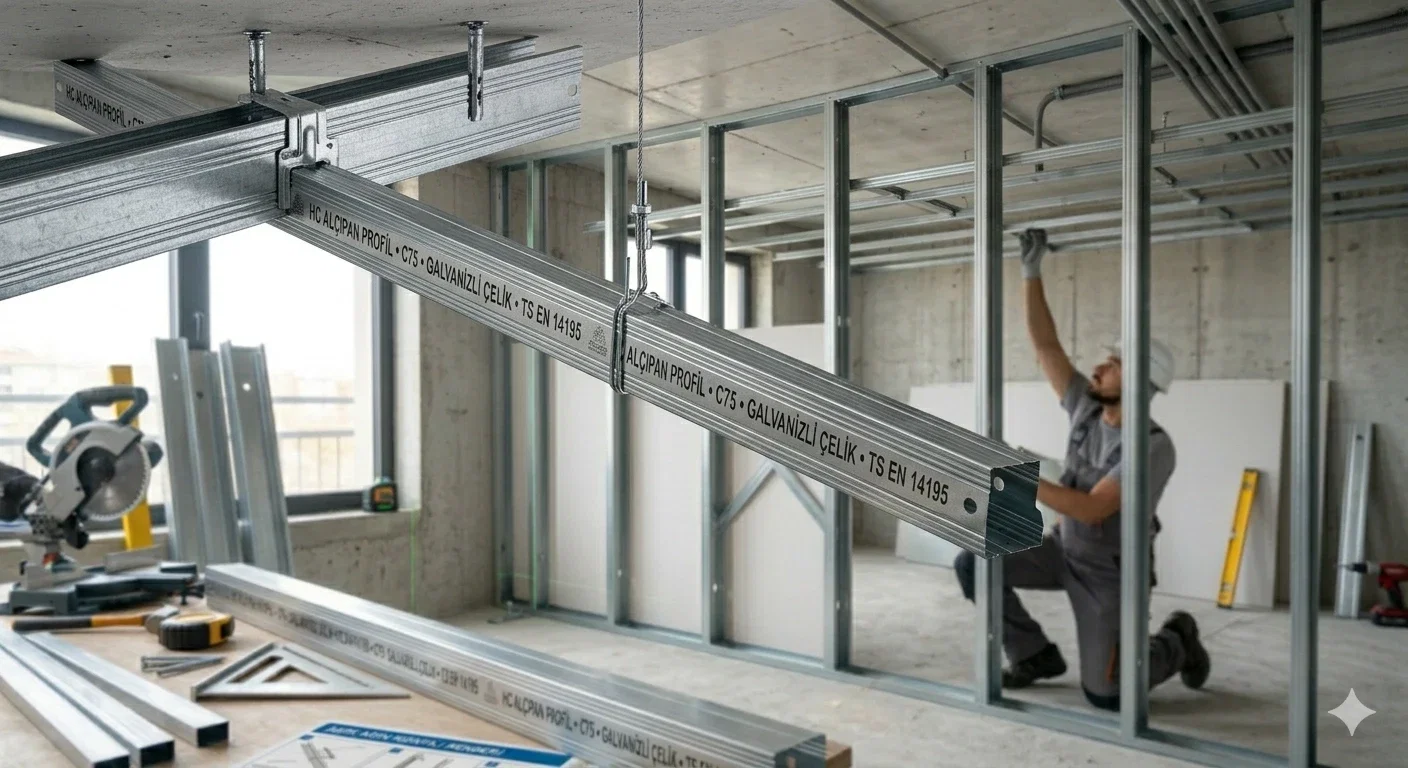
Ceiling C profiles are placed inside the channel formed by the U profiles fixed to the walls. However, statically, these profiles do not just sit inside the U profile; they are suspended from the existing concrete floor slab by means of hanger rods and brackets. In HC Drywall Profile installation standards, TC profiles are usually arranged in two layers (main carrier and secondary carrier). The first layer is hung from the ceiling, and the second layer is connected to it at a right angle with the help of clips. This cross-grid structure maximizes the stability of the system by spreading the load on the drywall over a wide area.
Importance of Geometric and Structural Differences Between the Two Profiles
The most obvious difference between Ceiling C and U profiles is in their edge structures. The edges of the U profile are flat because its duty is only to create a "bed" or "rail." The edges of the C profile are curved because these curves both increase durability and allow suspension elements (clips, brackets) to lock onto the profile. In HC Drywall Profile products, this geometric precision guarantees that the parts fit together perfectly during assembly. If you accidentally try to use the U profile as the main carrier instead of the C profile, the flexing of the profile and the displacement of the suspension elements will create an inevitable safety risk.
The Critical Role of Assembly Sequence in Suspended Ceiling Installation
Following the assembly sequence is the best way to understand which profile goes where. The process always begins with nailing the Ceiling U profile to the wall; this draws the "boundaries" of the system. Then, hanger rods are mounted to the ceiling. In the final stage, Ceiling C profiles are connected to these hangers, and their ends are slid into the U profiles on the wall edges. Our advice to HC Drywall Profile users is not to push the C profiles all the way to the end of the U profile. Leaving a gap of approximately 1 cm for the expansion allowance due to temperature changes of the metal is a hidden professional detail that prevents the ceiling from cracking over the years.
Screwing Priority and Profile Relationship in Gypsum Board Installation
Gypsum boards should never be screwed directly into the Ceiling U profile. The boards should only be fixed to the Ceiling C profiles. The U profile is only there to support the edge of the board. If you screw the board tightly to the U profile on the wall, the ceiling cannot stretch in case of building settlement or movement, and paint cracks appear at the corners. In HC Drywall Profile systems, the correct application is for the edge of the board to stand freely inside the U profile and for the main load to remain on the suspended C profiles.
The Impact of Profile Selection on Acoustics and Sound Insulation
Profile thickness and type are critical not only for strength but also for sound insulation. Thin and low-quality profiles vibrate more against sound waves, causing noise transmission. HC Drywall Profile’s TC profiles with a thickness of 0.50 mm and above minimize sound transmission thanks to their mass weight and rigid structures. Especially in suspended ceilings used in cinema rooms or office partitions, correctly selected C profiles create an excellent silence shield when combined with insulation materials placed inside them.
Need for Dilatation in Large Area Ceilings and Thermal Expansion
In large square meter areas (malls, airports, large offices), serious stress occurs on the ceiling skeleton. In such projects, it is not enough to just install C and U profiles; expansion joints (dilatation) should be left at certain intervals (usually every 10-12 meters). This application, specified in HC Drywall Profile technical documents, involves breaking the continuous line of C profiles and placing flexible transition elements in between. In this way, the expansion and contraction of the metal due to temperature differences in summer and winter months do not damage the general structure of the ceiling.
Vital Importance of Corrosion Resistance and Galvanized Coating Quality
Ceiling voids are usually areas where moisture and heat are trapped. If the galvanizing quality of the C and U profiles used is low, rusting of the metal over time is inevitable. A rusted C profile loses its load-bearing capacity and can cause the suspended ceiling to collapse. At HC Drywall Profile, we use high-micron hot-dip galvanized coating in all our productions. This ensures that suspended ceilings made in wet areas such as bathrooms and kitchens, or in humid coastal areas, maintain their safety for decades.
Including Lighting and Mechanical Installation Loads in Calculations
Suspended ceilings carry not only the gypsum board but also heavy chandeliers, hidden light coves, ventilation ducts, and sometimes fire extinguishing systems (sprinklers). In areas with such additional loads, the standard C profile arrangement may not be sufficient. HC experts recommend using "reinforced C profiles" or reducing the profile spacing to 30 cm at points where such heavy installations pass. The U profile does not have the capacity to carry this additional load; the load must be transferred to the suspension system connected to the ceiling.
Optimization of Profile Lengths and Site Waste
Just as correct profile selection is important, ordering profiles in lengths suitable for the dimensions of the project directly affects the cost. Standard 3-meter profiles may not always fit every room. HC Drywall Profile minimizes the waste rate at the construction site by producing C and U profiles in custom lengths for large projects. It is easy to join U profiles together, but special connection pieces must be used at the joints of C profiles, which are the main carriers, and these joints should be arranged in a staggered manner.
Labor Efficiency and Screw Holding Capacity
One of the most common complaints of installers is that the screw has difficulty penetrating the profile or the metal strips. HC Drywall Profile products have an ideal balance of hardness and flexibility. The special channels on the surface of our TC profiles prevent the tip of the screw from slipping and allow it to dive right into the center. This small detail shortens the labor time by up to 15% in a suspended ceiling project where thousands of screws are used. In the U profile, the smooth surface helps to ensure full contact with the wall and maintain the level.
Professionalism in Aesthetic Details and Corner Finishes
The quality of the finish where the suspended ceiling meets the wall determines the visual success of the entire project. Cutting the Ceiling U profile smoothly and joining it at 45-degree angles at the corners prevents the edges of the drywall from sagging. These corners, supported by HC branded finishing profiles, solve potential "hairline crack" problems from the start. Thanks to the movement allowance of the C profiles inside the U, the stresses occurring during building movements are not reflected in the corners, and a smooth appearance is preserved.
HC Assurance for Sustainability and Long-Lasting Structures
Installing the right profile in the right place is not just an assembly rule, but also the protection of national wealth. The renovation of ceilings that collapse or crack due to non-durable and incorrectly selected profiles costs many times the initial installation cost. As HC Drywall Profile, we contribute to sustainable architecture with our production in accordance with standards. The durability of our C and U profiles guarantees that the skeleton structure remains solid throughout the life of the buildings, ensuring efficient use of resources.
Conclusion: Secure Ceilings with Correct Choice and Professional Application
Understanding the differences between Ceiling C and Ceiling U profiles is to understand not just "how a suspended ceiling is made" but "why it is solid." Draw the boundaries with the U profile, and establish the strength with the C profile. Take your project to the next level with the engineering marvel solutions of HC Drywall Profile. Remember, the quality of your ceiling is hidden in the invisible parts, namely the correct profiles you choose. By following the steps in this guide in your application, you can achieve perfect results both aesthetically and structurally.