
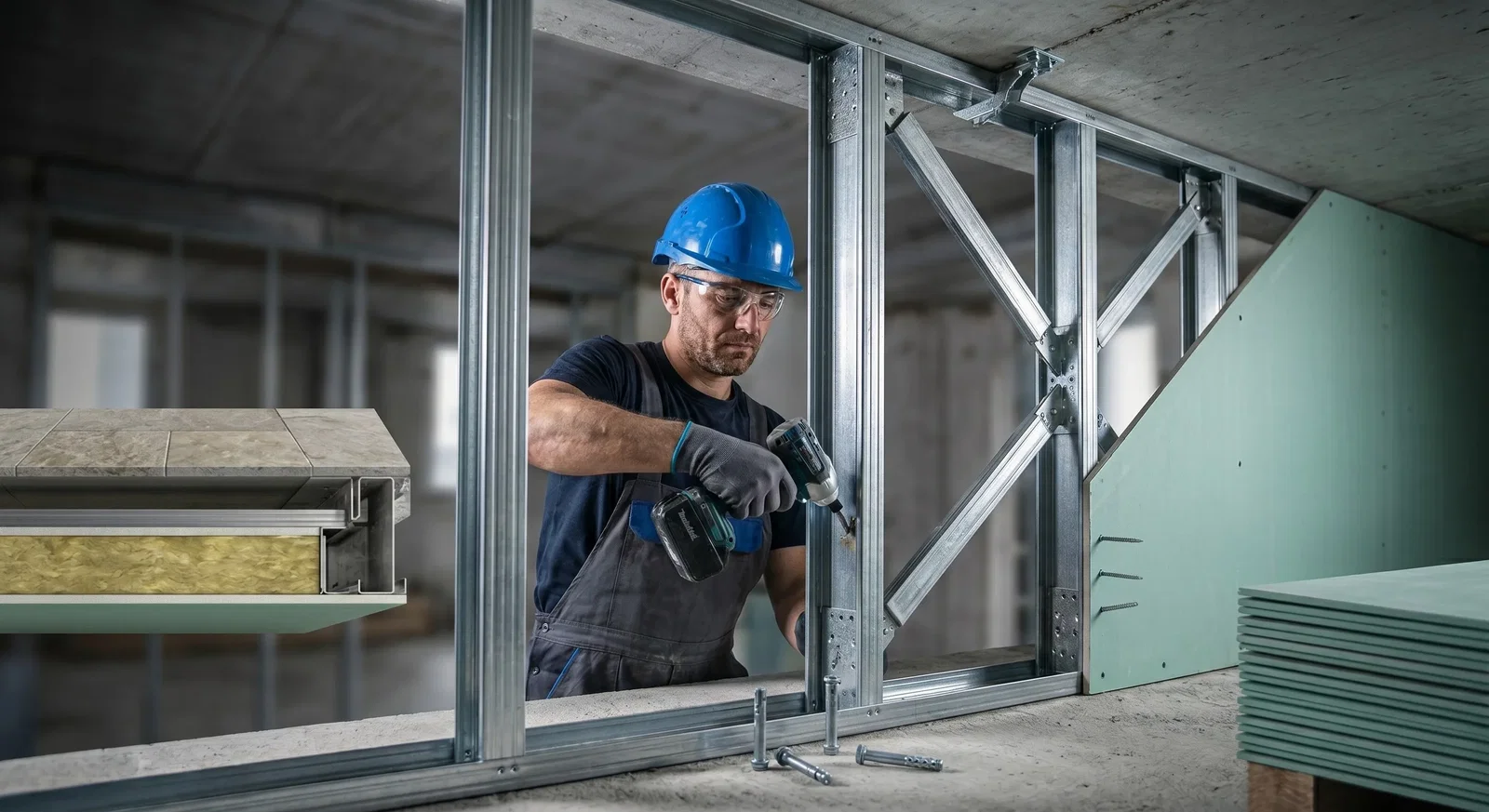
Gypsum Board Applications and Profile Fixation Methods in Accordance with the Earthquake Regulation.
Gypsum Board Applications and Profile Fixing Methods Compliant with Earthquake Regulations
In geographies located on active fault lines, such as Turkey, the biggest test for structures is their behavior during an earthquake. 2026 building inspection standards and current seismic codes mandate that not only the main carrier system but also architectural components like partition walls and suspended ceilings must be resistant to seismic loads. At HC Drywall Profile, we offer seismic profile solutions that adapt to the stretching movements of the building during a quake, ensuring they do not break and do not endanger life safety. Gypsum board systems built on a light steel skeleton exert much less load on the structure compared to traditional brick walls, thereby reducing the total seismic load of the building. A quake-resistant application is not just about choosing the right board; it is about configuring the profile skeleton that carries that board with fixing methods compliant with regulations.
Seismic Design Principles and Flexible Structural Behavior
The fundamental principle of gypsum board applications compliant with earthquake regulations is based on "ductility," or flexibility. During an earthquake, a building undergoes a certain amount of displacement (deformation); if interior partition walls are fixed so rigidly that they do not allow for this movement, cracking, toppling, or shattering occurs. HC Drywall Profile seismic systems are designed to leave a controlled movement area at the connection points of the profile with the main structure. This design approach allows the wall to sway along with the building while preventing the profile from dislodging or deforming. Flexibility ensures the dampening of seismic energy, minimizing the risk of damage to non-structural components of the structure.
The Critical Role of Profile Gauge Thickness and Steel Quality in Seismic Resistance
During an earthquake, the tensile and compressive forces acting on profiles are much higher than in standard applications. Profiles with low quality or insufficient gauge thickness may buckle during seismic tremors, causing the wall to collapse. HC Drywall Profile manufactures using high-strength galvanized steel as prescribed by earthquake regulations. The gauge thickness and zinc coating quality of our profiles delay metal fatigue, providing the necessary rigidity during a tremor. For seismic resistance, not only the design of the profile but also the modulus of elasticity and yield strength of the raw material used form the basis of our engineering calculations.
Seismic Suspension Systems and Safety in Ceiling Applications
Suspended ceilings are among the areas carrying the highest risk during an earthquake. Traditional ceilings connected to the main structure only by vertical wires can swing like a pendulum during tremors and dislodge. HC Drywall Profile seismic suspended ceiling systems are equipped with special seismic hangers and braces that limit lateral movements. In this system, not only is the ceiling prevented from falling, but its uncontrolled horizontal clashing is also inhibited. Seismic gaps left at the junction points of perimeter profiles with the wall prevent the ceiling from shattering by colliding with the wall. These fixing methods, developed by our engineering team, ensure that escape corridors remain open by maintaining the integrity of the ceiling during a tremor.
Seismic Fixing Methods in Floor and Ceiling Connections
The junctions of partition walls with the floor and ceiling are the heart of seismic design. According to regulations, "sliding joints" or "flexible connections" must be used when fixing the profile to floor and ceiling tracks (U-profiles). In HC Drywall Profile applications, stud profiles (C-profiles) are not fully fixed inside the top track; instead, a certain gap is left to provide vertical movement capability. In this way, displacements occurring between floors during an earthquake do not compress the wall profile. Seismic anchors and special washers used during the fixing phase prevent screws from stripping out of the metal, guaranteeing that the skeleton does not detach from the main structure.
Implementation of Seismic Gap and Expansion Joint Details
In large-scale areas or at points where the building's expansion (dilatation) lines pass, it is a major mistake for drywall walls to continue uninterrupted. Earthquake regulations require walls to be divided at these points and seismic gaps to be left. HC Drywall Profile seismic expansion profiles allow the wall to move as two separate pieces without disturbing visual integrity or insulation. These joint gaps prevent the stress generated during an earthquake from spreading to the entire wall, confining the damage to a specific point. A correctly planned seismic joint is the most important safety valve preventing the wall from shattering and toppling.
Strength-Enhancing Reinforcements at Corner and Junction Points
When seismic waves hit a structure, the highest stresses concentrate at the corner points of walls and around door/window openings. Standard profile applications may remain weak at these points. In HC Drywall Profile systems, studs made into "box profiles" or reinforced with stiffening sheets are used for door openings and corner junctions. These reinforcements prevent openings from losing their form during tremors and prevent heavy components like glass or doors from flying out. Cross bracing used in profile connections at corners increases the lateral rigidity of the wall, creating resistance against tremors in the "X" direction.
Impact of Seismic Anchor and Screw Selection on Connection Security
The quality of the elements used to fix the profile to the reinforced concrete or steel main structure must not be the weak link of the system. Earthquake regulations recommend the use of certified steel anchors that perform under seismic loads. In the assembly of the HC Drywall Profile skeleton, mechanical or chemical anchors resistant to impact and vibration should be preferred over standard plastic anchors. The gripping surface and thread structure of the screw into the profile flanges are also specially designed so they do not loosen during tremors. Without the use of the correct fixing element, even the world's strongest profile can break free during the first tremor.
Preserving Profile Integrity in Installation Passages
In industrial or commercial structures, numerous electrical and mechanical installation lines pass through drywall walls. Gaps opened in the profile for these installations can lower the static values of the profile if placed incorrectly. HC Drywall Profile offers factory-made passage holes positioned during production in a way that does not disturb the strength of the profile. To counter the risk of installation pipes tossing inside the wall and damaging the profile during an earthquake, flexible clamps and fire-stopping seismic pillows should be used at pipe passages. These details prevent secondary damages (flooding, short circuits, etc.) caused by installations after a tremor.
Seismic Fixing of Heavy Loads to the Profile Skeleton
Fire cabinets, televisions, or heavy shelves hung on the wall turn into massive inertial forces during an earthquake. Hanging these loads directly on the gypsum board can result in disaster during a quake. HC Drywall Profile offers special support profiles and load-distributing plates integrated into the skeleton for carrying heavy loads. According to seismic fixing methods, the center of gravity of these heavy loads must be transferred to the profile system and from there to the main structure. To prevent these loads from creating a "whip effect" and knocking down the wall during tremors, the connections of load-bearing profiles to the floor and ceiling are reinforced with extra seismic screws.
Use of Seismic Tapes and Vibration-Damping Layers
Seismic insulation tapes used at points where the profile makes contact with the reinforced concrete surface provide not only sound insulation but also earthquake safety. HC Drywall Profile seismic tapes optimize the friction between metal and concrete and absorb the vibration energy passing from the structure to the profile. Directly transferring the high-frequency vibrations the building makes during an earthquake to the profile skeleton can lead to screws snapping due to metal fatigue. These elastic layers soften the mechanical bond of the metal with the concrete, allowing the system to dampen "intelligently."
Application Errors and Seismic Inspection Processes
An earthquake-resistant drywall system only comes to life through correct application. Errors often made on construction sites, such as "screwing profiles together too tightly" or "failing to leave seismic gaps," leave the system defenseless against earthquakes. At HC Drywall Profile, we provide technical training and seismic assembly guides for application teams. During the inspection phase, the compliance of profile axis spacing with regulations (usually 40 cm or less in seismic zones), the number of anchors, and the angle of seismic hangers must be meticulously checked. A faulty fixing detail can create a domino effect causing the failure of the entire system during an earthquake.
Seismic Performance Analyses and Tested Systems
In the 2026 construction world, it is expected that no untested system should take part in critical projects. HC Drywall Profile seismic wall and ceiling systems are products whose performance values have been proven by testing on shaking tables in laboratory environments. During these tests, the breaking points of the profile, the stripping loads of the screws, and the durability of the suspension systems are measured. This data provided to our engineers ensures that project-specific seismic calculations (ETA and CE certified) are made correctly. Using a tested system is the greatest guarantee that the building will be quickly reusable after an earthquake (business continuity).
Sustainability and Post-Earthquake Waste Management
An earthquake-resistant design should consider not only the moment of the tremor but also the aftermath. When traditional heavy walls collapse, they create tons of rubble waste that takes weeks to clear. HC Drywall Profile systems, thanks to their lightness, reduce the additional load on the building after an earthquake and can be quickly disassembled and renewed in case of possible damage. The 100% recyclability of steel profiles ensures that the environmental impact remains low during post-earthquake repair processes. Durable design means the material survives the tremor with minimal damage and repair costs stay at a minimum.
Conclusion: Secure Future and Seismic Protection with HC Drywall Profile
Gypsum board applications compliant with earthquake regulations are a result of the combination of technical knowledge and quality materials. As the HC Drywall Profile brand, we place Turkey's earthquake reality at the center of our product development processes. With correct profile fixing methods, seismic suspension details, and high steel quality, we protect not just buildings, but the lives within them. By combining the flexibility and lightness needs of modern architecture with seismic safety standards, we help you build spaces that remain standing and functional even after an earthquake. The structures of the future rise on more peaceful and solid foundations with the seismic assurance of HC Drywall Profile.