

How to Calculate the Stretch Share in a Drywall Profile Static
How is the Flexibility Allowance Calculated in Drywall Profiles? Ways to Avoid Static Errors Engineering Foundations of Static Safety and Flexibility Allowance in Drywall Systems Suspended ceilings and partition wall systems, although they are not directly part of a building’s static load, require serious engineering calculations due to their own weight and the mechanical loads that sit on them.
Every profile we produce as HC Drywall Profile is designed with the metal’s natural flexibility and strength balance in mind. Incorrect calculation of the flexibility allowance during installation can, over time, cause hairline cracks on drywall surfaces, joint separations, and, worse, lead the system to sag and collapse.
The first step to avoiding static errors is to correctly analyze the amount of load the profile will be subjected to and the metal’s coefficient of expansion. Flexibility Limits and the L/360 Criterion in Metal Profile Design The amount a drywall profile must flex is typically determined by the L/360 formula in international construction standards.
In this formula, “L” represents the distance between the two support points of the profile. For example, the acceptable maximum flex at the center of a 300 cm long C‑profile is about 0.83 cm.
HC Drywall Profile technical specifications emphasize that to keep these limits from being exceeded, the profile thickness and the spacing between axes must be optimized for each project. If the calculated sag exceeds this limit, the plate thickness should be increased or the spacing of the suspension elements revised.
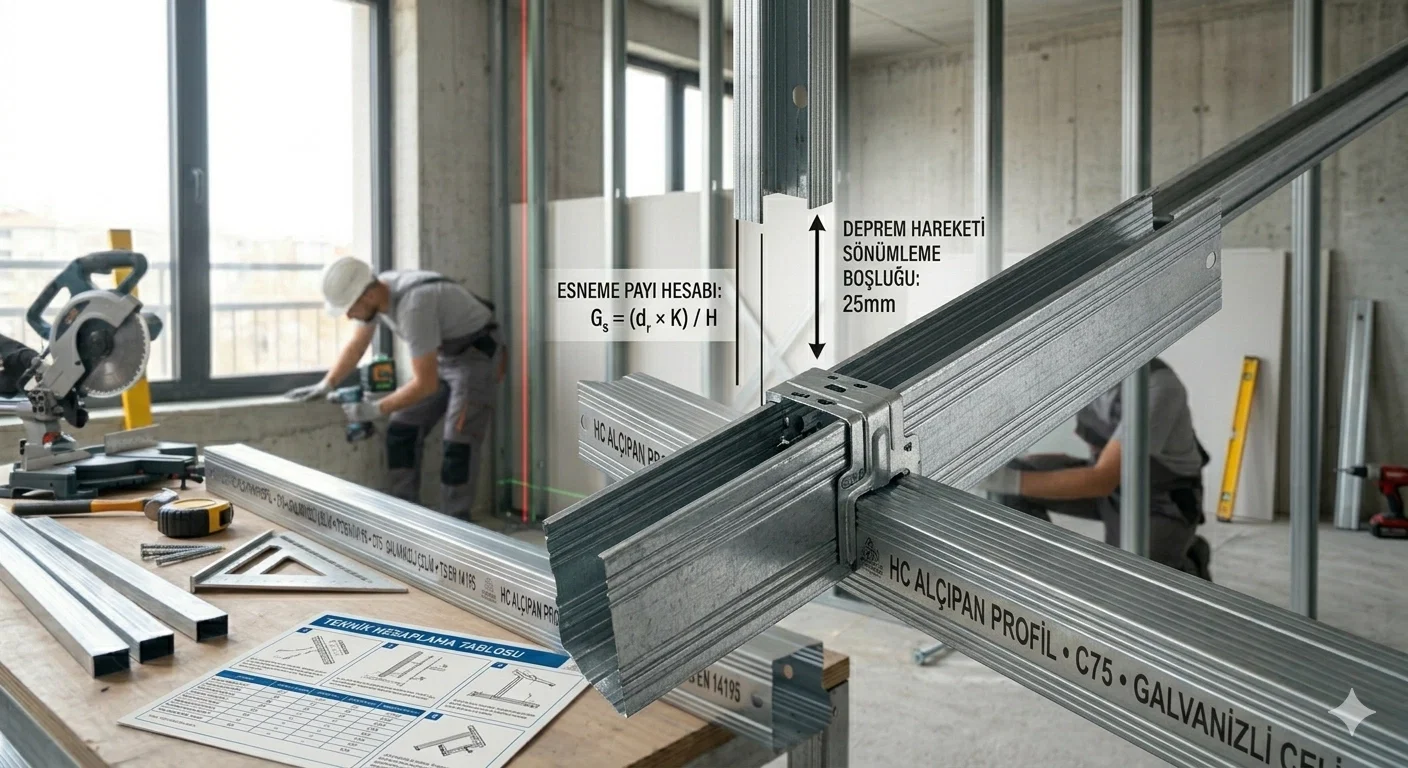
Need for Axial Expansion and Dilatation Allowance Due to Temperature Changes Metal structures respond to changes in ambient temperature with axial expansion or contraction. Even though HC Drywall Profile products are made from high‑quality galvanized steel, it is vital to leave an expansion allowance of about 1 to 1.5 cm on every continuous 10‑meter run.
In large suspended ceilings, if the profile ends are forced to sit flush against the U‑profile in the wall, the profile will bend during expansion and the ceiling will “sag.” To avoid this static error, gaps that allow movement must be left at the profile ends. Critical Role of Suspension Elements in Static Load Distribution In suspended ceiling systems, most of the load is borne by the suspension rods and nails that attach the profiles to the ceiling, rather than by the profiles themselves.
As stated in the HC Drywall Profile installation guide, the load‑carrying capacity of each suspension element must be calculated based on the weight of the profile and the number of drywall sheets that will be attached. To avoid a static error, the distance between suspension points should be kept between 90 and 120 cm as per standards.
Exceeding this range increases the moment on the profile and pushes the metal beyond its elastic limit, causing irreversible bending. Profile Rigidity and Wind Load Analysis in Partition Walls Partition walls facing the exterior or high‑ceiling spaces must resist not only vertical weight but also pressure and wind loads.
HC Drywall Profile’s wall C‑profiles have a special geometry designed to withstand these lateral pressures. In static calculations, as wall height increases, the profile width (e.g., 75 mm or 100 mm) and plate thickness must be increased.
Failure to control lateral flexion creates chronic cracks at door openings and wall junctions. Extra Load Calculation in Double‑Layer Drywall Applications Double‑layer drywall applications chosen for acoustic performance or fire resistance double the static load on the profile skeleton.
HC Drywall Profile standards recommend reducing the axis spacing from 60 cm to 40 cm, and in some cases to 30 cm. When calculating the flexibility allowance, the metal’s weight and the approximate 25–30 kg/m² drywall weight must be included.
Standard installations that ignore this weight cause the system to sag over time. Effect of Profile Thickness on Static Resistance and Screw Holding Power Low‑quality, thin‑plate profiles found on the market can distort the metal’s shape when screws are driven, creating static weakness.
HC Drywall Profile’s 0.50 mm and 0.60 mm thick profiles ensure the screw locks fully into the metal. When calculating the flexibility allowance, local deformations at screw points should also be considered as a margin of error.
If the profile is too thin, screw holes can widen under load, disrupting the system’s balance and causing micro‑level movements that lead to joint cracks. Strategies to Prevent Stress Accumulation at Corners and Joints Corners where suspended ceilings meet walls (L‑corners) are the areas where stress accumulates most.
Most static errors arise from overly rigid connections between profiles at these points. According to HC Drywall Profile expertise, the ceiling skeleton should “float” independently of the building.
The wall profile (U‑profile) is fixed to the wall, but the ceiling profile (C‑profile) should be free to move within the channel, dissipating the energy generated by building sway. Without this flexibility, cracks begin at the weakest points—corners.
Principles of Suspension for Plumbing Loads and Mechanical Equipment Ventilation ducts, heavy lighting fixtures, or fire systems are often mounted on the drywall profile skeleton, which is a major risk from a static perspective. In HC Drywall Profile systems, an independent suspension system must be installed for any load that exceeds the profile’s own capacity.
If plumbing will be attached to the profile, the number of profiles in that area should be increased and the skeleton reinforced with additional support profiles. When calculating the flexibility allowance, it is recommended to include an additional 20 % safety margin for these unpredictable loads.
Indirect Effect of Corrosion on Static Strength in Humid Environments In bathrooms, kitchens, or seaside projects, corrosion is the greatest enemy that undermines the structural integrity of metal. A corroded profile loses flexibility and becomes brittle.
HC Drywall Profile’s high‑micron galvanized coating prevents oxidation, keeping static calculations valid for decades. When calculating the flexibility allowance in humid environments, the metal’s potential to weaken over time should be assumed, so a higher safety factor and corrosion‑resistant accessories should be chosen.
Damage to System Stability from Incorrect Profile Cutting One of the most common static errors on construction sites is cutting profiles with the wrong tools, deforming the ends. A flattened profile end does not fit properly into the U‑profile, causing uneven load transfer.
HC Drywall Profile recommends using a saw or cutter that does not distort the metal’s face. When the geometric shape is altered, the strength values no longer match the data on paper, leading to surface defects caused by local flexion differences.
Use of Reinforced Profiles in Long Corridors and Wide Openings In long, narrow spaces such as corridors, wind corridors can create a vertical pressure differential on ceilings. In such cases, standard profiles may not provide enough flexibility.
HC Drywall Profile’s technical unit recommends using box‑profile reinforcements or thicker main carriers in these special areas. To reduce the static error margin to zero, the sag calculation should be checked every 2 m in long openings, and additional positions for main carriers should be strategically placed.
Effect of Screw Frequency and Arrangement on Profile Flexibility The frequency of screws attaching drywall to the profile determines the system’s overall ability to move. Screws that are too close lock the profile too tightly; screws that are too sparse allow the sheet to move independently on the profile, causing screw heads to break.
HC Drywall Profile installation standards specify screw spacing of 25–30 cm, reduced to 15 cm at edge joints, to achieve ideal static balance. This arrangement ensures a homogeneous load distribution on the profile, preventing local flexion accumulations.
Building Movements and Seismic‑Isolated Profile Applications In seismic zones, micro‑level building sway is a major stress source for drywall systems. To avoid static errors, seismic gaps and flexible connectors should be used.
HC Drywall Profile offers clips and nail systems with the required flexibility to allow the ceiling to move with the building without breaking. A rigid, non‑flexible system will collapse under even the slightest tremor, whereas a properly calculated flexibility allowance preserves structural safety.
Correct Determination of Floor and Ceiling Levels Before Installation Some static errors begin at the very start of installation, with level inaccuracies. In a curved level, the load distribution on the profile skeleton becomes asymmetric.
One side may be within calculated limits while the other becomes overloaded. HC Drywall Profile applications use laser levels to guarantee equal load distribution across the entire skeleton.
Equal load distribution keeps the flexibility allowance constant at every point, preserving the aesthetic form of the ceiling or wall for a lifetime. Site Fires and Economic Profile Size Optimization Choosing the correct profile sizes at the project stage reduces cost and eliminates extra material, thereby increasing static resistance.
HC Drywall Profile produces custom sizes for your project, preventing unnecessary add‑on pieces. Every extra piece is a potential weak point from a static perspective and changes the flexibility characteristics.
Continuous profiles create skeletons that perform closest to the calculated sag values and have the lowest static error margin. Safe and Long‑Lived Applications with HC Drywall Profile In conclusion, the flexibility allowance in drywall systems is not an error but an essential engineering parameter for healthy operation.
The key is keeping this flexibility within controllable limits. At HC Drywall Profile, we provide the technical specifications that ensure this control on every piece leaving our production line.
When the right profile, correct axis spacing, and professional workmanship come together, creating aesthetic and safe living spaces free from static errors becomes inevitable. By choosing HC’s guarantee for your projects, you can build both today and tomorrow on solid foundations.