
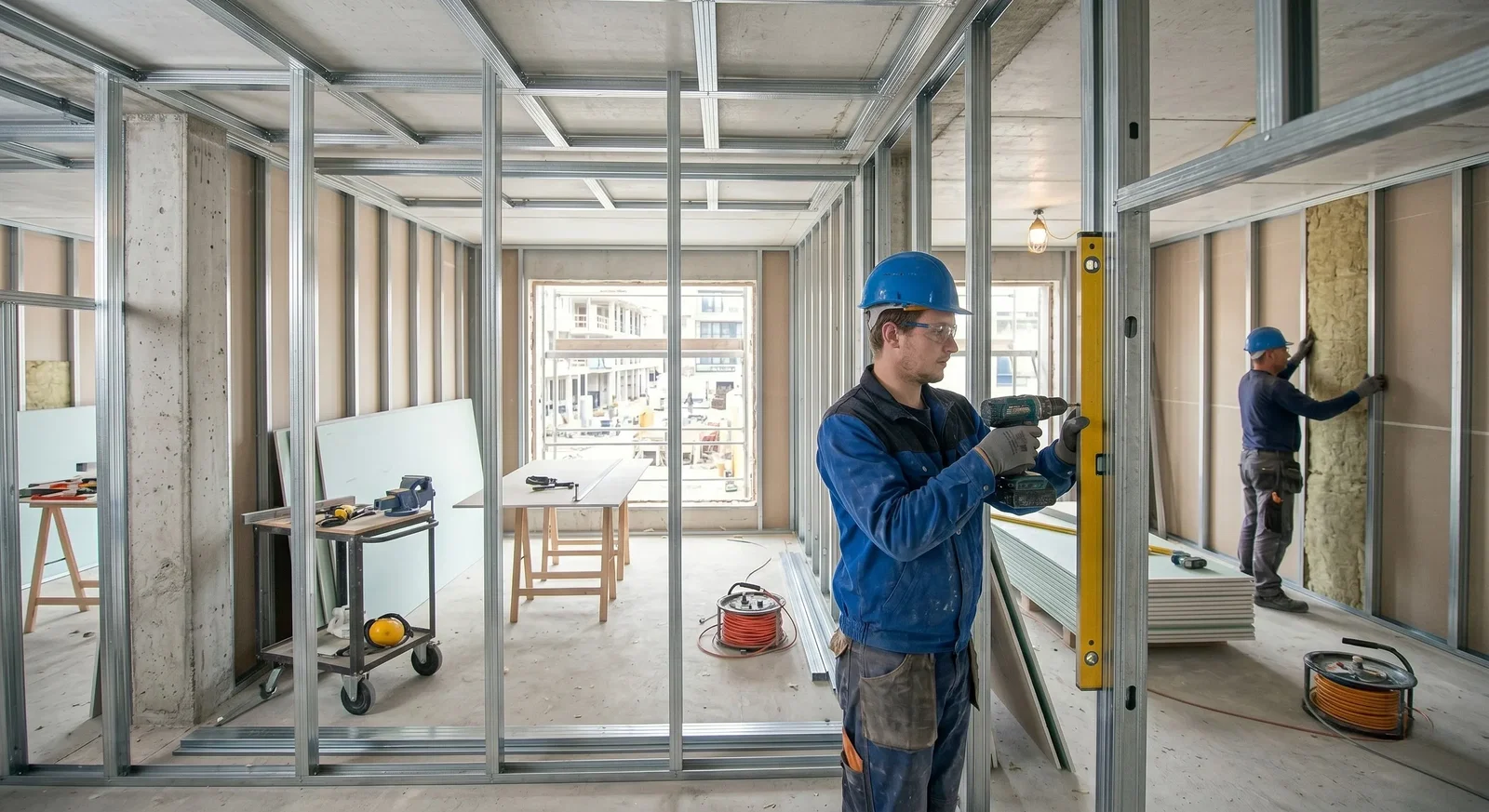
How to Identify a Quality Profile in Drywall Profiles with TSE Standards
Importance of TSE Standards as a Symbol of Trust in the Construction Sector
The quality of materials used in construction projects determines not only the aesthetic appearance but also the lifespan of the structure and human safety. The criteria established by the Turkish Standards Institute (TSE) define the minimum physical and chemical properties a drywall profile must possess. At HC Drywall Profile, ensuring that every product leaving our production line is fully compliant with these national standards is a testament to our commitment to engineering ethics. A TSE-certified profile proves that it has passed various laboratory tests and that every detail, from raw material quality to bending precision, has been approved. While using non-standard products may seem like a cost advantage in the short term, it leads to structural failures and irreparable renovation expenses in the long run.
First Criterion of a Quality Drywall Profile: Raw Material and Steel Grade
The most fundamental element forming the skeleton of a drywall profile is the quality of the steel sheet used. According to the TSE EN 10346 standard, the sheets used in production must have a specific tensile strength and elasticity coefficient. HC Drywall Profile uses only structural grade steel sheets sourced from reliable iron and steel manufacturers. A high-quality profile should not yield excessively when pressure is applied by hand, yet it should not be brittle against impacts. Profiles produced from low-quality, non-standard sheets cannot bear the load imposed on them and lose their form over time, causing cracks in the drywall boards.
Relationship Between Galvanized Coating Amount and Corrosion Resistance
Corrosion, or rusting, is the greatest enemy of metal profiles; it is not just a visual issue but a process that destroys the profile's load-bearing capacity. TSE standards require the amount of zinc coating (gr/m²) on the surface of the profiles to be above a certain level. The high-grammage galvanized coating used in HC Drywall Profile products completely isolates the metal from moisture and oxygen in the external environment. One way to identify a quality profile is to look at the homogeneity of the surface brightness and the distribution of zinc crystals (spangles). If there are dull spots or black stains on the profile, it indicates low galvanization quality and is a harbinger of rapid rusting.
Profile Wall Thickness and Accuracy of Micrometer Measurements
Many profiles sold under the name "economic" in the market fall below the declared wall thickness values. TSE standards expect a profile sold as 0.50 mm, for example, to maintain this thickness within designated tolerance margins. HC Drywall Profile uses control mechanisms operating with millimetric precision in its production processes to guarantee the declared wall thickness at every point. A simple measurement with a micrometer or caliper reveals the integrity of the product. Profiles with thin sheets reduce screw holding capacity and cause sagging effects, particularly in suspended ceilings.
Impact of Geometric Form and Bending Precision on Installation
The quality of a drywall profile is indicated not only by its thickness but also by the regularity of its form. The fact that channels are perfectly parallel and bending angles meet at a flawless 90 degrees directly affects installation speed and quality. Profiles shaped in HC Drywall Profile’s advanced technology roll-forming machines do not "spring back" or "twist." In poor-quality profiles, cracks or crookedness are observed at the bending points. This prevents the profile from fully aligning with the drywall sheet and causes deviations from the level. Bending in accordance with standards provides structural support that increases the strength of the profile.
Function of Knurling and Screw Channels on the Profile
A high-quality drywall profile features special knurling and channels on its surface that facilitate screw installation. This surface texture, designed in accordance with TSE standards, prevents the screw from slipping during assembly and ensures a tighter grip on the metal. The distinct screw paths seen in HC Drywall Profile products minimize workmanship errors. If a profile surface is completely smooth and rejects the screw, it can be said that the product lacks engineering design. Correct surface design also increases the rigidity of the profile, providing resistance against bending.
TSE Marking and Product Traceability
A profile that has passed a genuine quality control process must have indelible marking containing the manufacturer's brand, the TSE logo, and the production date. HC Drywall Profile strictly adheres to these traceability rules on every product line. These markings on the profile are the most concrete evidence that the manufacturer stands behind its product. Unnamed and uncertified products carry the risk of "under-the-counter" production. Since the origin and quality of the raw materials used in such products are uncertain, serious problems can arise during building inspection processes.
Results of Deflection and Sagging Tests Under Load
In suspended ceiling systems, profiles are under a constant tensile load. In TSE tests, the amount of deflection (sagging) a profile exhibits under a certain weight is measured. HC Drywall Profile designs are optimized to carry even the heaviest drywall boards with minimum deflection. A quality profile should possess an elasticity that allows it to return to its original form once the load is removed. Profiles that undergo permanent deformation cause ceilings to sag or walls to bulge over time. This fine balance between hardness and flexibility can only be achieved in TSE-approved production facilities.
Contribution of the Profile to Sound and Heat Insulation Performance
Drywall systems are not just partition walls; they are also insulation layers. The quality of the profile affects the acoustic performance of the system as well. Thick and standard-compliant HC Drywall Profile series prevent the formation of sound bridges thanks to their ability to dampen vibrations. Thin and low-quality metal sheets act as a diaphragm that aids sound transmission, negatively affecting insulation. The stable posture of the profile against thermal expansion prevents heat insulation boards from shifting and weakening the insulation.
Fire Resistance and Thermal Response Classification
The behavior of construction materials in the face of fire is the most critical issue for life safety. Although drywall profiles are in the class of non-combustible materials, how long they maintain their load-bearing capacity under high heat is vital. TSE standards test the mechanical resistance of profiles during a fire. HC Drywall Profile prefers steel alloys that maintain their form the longest under heat when forming the skeleton of fire-resistant systems. Profiles that are corroded or produced too thin can melt rapidly during a fire, causing the system to collapse within minutes.
Role of Packaging and Logistics Standards in Product Quality
No matter how high the quality of a profile is when it leaves the factory, it must maintain its form until it reaches the construction site. TSE standards also provide guidelines regarding the transportation and storage conditions of products. HC Drywall Profile packages its products to prevent deformation and offers logistic solutions protected against moisture. The fact that profile bundles arriving at the site are not scattered and profiles have not been crushed by intertwining demonstrates the operational strength of a quality brand. It is impossible to achieve a smooth drywall application with crushed or bent profiles.
Screw Stripping and Metal Fatigue During Application
Screws stripping the profile during installation leads to both loss of time and decreased safety. A quality profile has an ideal hardness where screw threads will grip the metal strongly. Screw-holding tests conducted in HC Drywall Profile laboratories confirm that our products do not strip even at the highest torque values. These profiles, resistant to metal fatigue, do not release the screw even under the micro-vibrations the building will be exposed to throughout its lifespan. In non-standard products, screws may loosen due to the softness or extreme brittleness of the metal.
Chemical Analysis and Environmentally Friendly Production Processes
TSE standards now inspect not only physical durability but also the environmental impact of products. HC Drywall Profile uses coating technologies that do not contain heavy metals harmful to human health. A quality profile does not release harmful chemicals during installation or throughout its service life. The purity of the zinc coating both extends the life of the profile and provides a cleaner raw material to the economy during recycling processes. This sustainability vision is an integral part of our brand's understanding of quality.
Facilitating Role of the TSE Certificate in Site Inspections
Building inspection firms and control engineers strictly monitor the compliance of materials used with standards. The use of HC Drywall Profile on-site ensures the acceleration of inspection processes and the smooth operation of approval mechanisms. Products without a TSE certificate necessitate taking samples and sending them to a laboratory, which leads to time loss in the project. Using a quality profile means securing the project not only physically but also legally and bureaucratically.
Economic Life and Total Cost of Ownership Analysis
Evaluations made based on unit prices when choosing a profile are often misleading. The waste rates, application difficulties, and future crack repair expenses caused by a low-quality profile far exceed the initial price difference. HC Drywall Profile offers the most advantageous solution in total cost of ownership with its long economic life. The most definitive way to recognize a quality profile is to see not even a minor sag, crack, or rust stain on the wall or ceiling years after its use.
Strong and Safe Futures with HC Drywall Profile
In conclusion, a quality drywall profile distinguishes itself with its certified raw material, precise dimensions, high corrosion resistance, and honest production approach. As the HC Drywall Profile brand, we have built our entire production capacity on maintaining these quality parameters. We view TSE standards not just as a necessity but as a requirement of the respect we have for our customers. We continue to be the hidden but strongest supporter of your structures with our profiles that challenge the years, meet technical specifications fully, and can be used with confidence in your projects. Seek quality in the details for the right choice, a strong skeleton, and a safe future.