
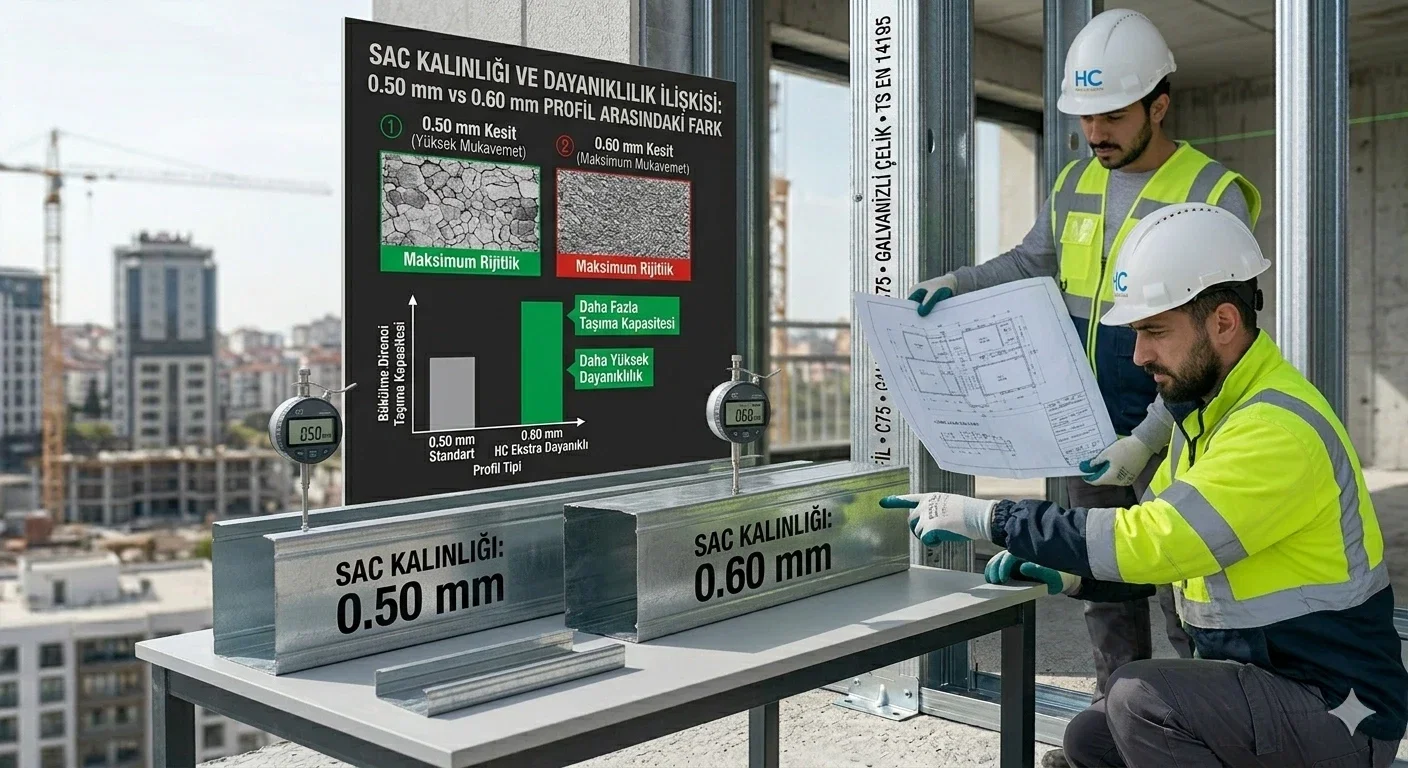
Relationship Between Sheet Thickness and Durability: Difference Between 0.50 mm and 0.60 mm Profiles.
Engineering Relationship Between Sheet Thickness and Structural Durability
The most fundamental physical property determining the performance of metal profiles used in the construction industry is sheet thickness. Thickness is the primary determinant of a profile's resistance under static loads, its deflection margin, and its total load-bearing capacity. At HC Drywall Profile, we treat the difference between 0.50 mm and 0.60 mm not merely as a unit of measurement, but as engineering data that directly impacts structural safety. As thickness increases, the molecular density of the metal—and consequently its ability to withstand external forces—shows a linear increase. This is vital for maintaining system stability, particularly in wide-span suspended ceilings and high partition wall applications.
Comparison of Mechanical Load-Bearing Capacity of 0.50 mm and 0.60 mm Profiles
From a mechanical perspective, a profile with a sheet thickness of 0.60 mm possesses a much higher moment of inertia than a 0.50 mm profile. The moment of inertia represents a material's resistance to bending. Pressure tests conducted in HC Drywall Profile laboratories demonstrate that this 20% increase in sheet thickness results in a performance difference far exceeding 20% in terms of load-bearing capacity. 0.60 mm profiles handle the weight of drywall boards and insulation materials much more rigidly. Conversely, 0.50 mm profiles are designed to offer an optimum solution for interior applications with standard ceiling heights where the load is lighter.
Effects on Deflection Rates and Post-Application Surface Smoothness
One of the most significant aesthetic problems encountered in drywall applications is sagging over time, known as deflection. Profiles with insufficient sheet thickness can bow at a millimetric level due to constant loads, leading to cracks at joints and a wavy appearance. The 0.60 mm thickness option in HC Drywall Profile production minimizes the deflection rate, ensuring the ceiling or wall maintains its original smoothness for years. When used with correct axis spacing (e.g., 40 cm or 50 cm), 0.50 mm profiles provide an excellent price-performance balance for standard residential projects. However, for high-ceiling commercial areas, 0.60 mm is an indispensable choice to prevent aesthetic defects.
Static Limits of Sheet Thickness in Partition Wall Heights
In partition wall systems, as the height of the wall increases, the pressure of lateral forces—such as wind load and impact effects—on the profile increases. While 0.50 mm thick profiles serve safely up to a certain height limit (generally around 3 meters), 0.60 mm thickness becomes mandatory for walls exceeding this limit. HC Drywall Profile technical specifications recommend using thicknesses of 0.60 mm and above in high corridors, warehouse walls, or massive interior spaces like cinema halls. Using thin sheets on high walls poses a risk of "oscillation," which causes the wall to shake and damages the surface cladding.
Difference Between Screw Holding Strength and Installation Safety
The screws connecting the drywall board to the profile transfer the entire load to the thin wall of the metal. The thicker the sheet, the more tightly and deeply the screw threads grip the metal. In HC Drywall Profile 0.60 mm products, screw holding strength is significantly higher compared to 0.50 mm products. This is a critical safety factor, especially in double-layer drywall applications or surfaces where heavy decorative panels will be hung. While the risk of the screw "stripping" the metal is higher in 0.50 mm profiles, 0.60 mm steel minimizes this risk, allowing the installer to work faster and more securely.
Role of Sheet Density in Acoustic Performance and Sound Insulation
Sound insulation is directly related to the mass law; as the density of a material increases, the sound transmission loss also increases. Because 0.60 mm profiles have more metal mass than 0.50 mm ones, they are a step ahead in blocking the transmission of low-frequency sounds. Increasing sheet thickness in HC Drywall Profile skeletal systems improves acoustic comfort by increasing the total mass of the wall. Furthermore, thicker sheets vibrate less, making it harder for sound to be transmitted through the metal (structural sound transmission). In places where sound privacy is paramount, such as office partitions and hotel rooms, 0.60 mm profiles form the foundation of a quiet environment.
Profile Behavior Against Thermal Expansion and Linear Elongation
Buildings are living organisms that react to temperature changes. Metal profiles expand when heated and contract when cooled. Profiles with a sheet thickness of 0.60 mm have higher resistance to thermal stresses than 0.50 mm ones. The homogeneous structure of HC Drywall Profile products minimizes "cracking" sounds and surface deformations caused by thermal changes. Thicker profiles absorb thermal movements better, balancing the stresses that may occur at the joints of drywall sheets. This feature is a major advantage, especially for walls near the exterior facade or in areas where heating and cooling systems operate intensively.
Resistance to Crushing and Deformation under Site Conditions
Construction sites are dynamic and harsh environments. Profiles may be stepped on, struck during transport, or improperly stacked while waiting for installation. 0.60 mm profiles are much more resistant to such physical stresses. The HC Drywall Profile 0.60 mm series maintains its form against crushing and bending on-site, whereas 0.50 mm profiles require more delicate handling. Deforming the geometric form of the profile prevents the drywall board from being properly leveled; therefore, 0.60 mm profiles offer logistical reliability that increases application speed and precision.
Fire Resistance and Load-Bearing Duration Under Heat
According to fire regulations, carrier systems must remain standing under load for a specific duration. Metal does not melt easily, but it rapidly loses its strength at high temperatures. As sheet thickness increases, the metal's heat absorption capacity increases, and the time it takes to reach critical temperatures is extended. Using 0.60 mm steel in HC Drywall Profile products pushes the collapse time of the skeleton further compared to 0.50 mm. This extra time allows fire insulation boards to continue functioning, creating a vital window for building evacuation and fire intervention.
Cost Analysis and Return on Investment: Savings or Quality?
Although 0.50 mm profiles appear more economical in terms of initial investment, 0.60 mm profiles can be more profitable when considering the total lifespan of the project. For long-lasting structures that require no maintenance, sheet thickness should not be compromised. At HC Drywall Profile, we recommend 0.50 mm for standard ceilings and 0.60 mm for areas where high performance and safety are expected. Repairing a ceiling a few years later due to incorrect thickness selection means spending far more than the initial savings. Correct thickness is the key to a sustainable building economy.
Roll-Forming Technology and Thickness Precision
The quality of the roll-forming machines used during profile production ensures that the same thickness is maintained at every point of the sheet. In some sub-standard productions, the edges of the sheet may differ in thickness from the center. HC Drywall Profile guarantees that every product declared as 0.50 mm or 0.60 mm is accurate to one-hundredth of a millimeter, thanks to our high-tech production line. This precision ensures a perfect fit at the interlock points of the profiles and increases the total rigidity of the system.
Earthquake Safety and Flexibility of Light Steel Skeletons
In countries located in earthquake zones, the flexibility of interior partitions is critical for life safety. 0.60 mm profiles are strong enough to prevent the system from falling apart under seismic loads, yet light enough not to place excessive weight on the building. HC Drywall Profile provides the ideal sheet thickness balance for carcass systems compliant with earthquake regulations. The high screw-holding capacity of thicker profiles significantly reduces the risk of drywall boards detaching and falling during tremors.
Relationship Between Galvanized Coating, Corrosion Resistance, and Thickness
Sheet thickness is not just about strength; it also plays an indirect role in corrosion resistance. Rusting begins at the surface of the metal and moves inward. It takes longer for a 0.60 mm profile to lose its load-bearing capacity due to corrosion compared to a 0.50 mm profile. HC Drywall Profile maximizes corrosion resistance by using high-grammage galvanized coating in both thickness segments. However, preferring 0.60 mm thickness in very humid or corrosive environments acts as an additional insurance policy ensuring structural safety.
Wall Thickness Advantage in Wide Flange and Channel Designs
The geometric design of the profile—its channels and bending points—shows its true strength when combined with sheet thickness. Wide-flange profiles made from 0.60 mm steel resist deformation even if a screw deviates from its target during application. HC Drywall Profile’s specially designed bending points utilize the stiffness of the 0.60 mm sheet to prevent the profile from "twisting." This helps the profile stay on a perfectly straight axis throughout the installation line, eliminating the risk of being out of level.
Project-Specific Solutions: When to Choose 0.50 or 0.60?
Choosing the right profile depends on a correct analysis of the project's needs. For standard suspended ceilings, decorative niches, and low-traffic interior walls, 0.50 mm HC Drywall Profile products provide both lightness and economic advantages. However, for shopping malls, hospitals, schools, and walls behind exterior facades exposed to wind loads, a 0.60 mm sheet thickness is a technical necessity. For professionals wishing to keep the factor of safety high in engineering calculations, 0.60 mm is always the safer harbor.
Quality Assurance of the HC Drywall Profile Brand
The hidden heroes of construction, profiles are invisible once the application is finished, yet they carry the entire load of the structure. HC Drywall Profile responds to all architectural requirements with its 0.50 mm and 0.60 mm options, implementing comprehensive quality control tests at every stage. With our production fully compliant with international standards, our honesty regarding sheet thickness, and the technical support we provide to projects, we continue to be the reliable partner of the construction sector. The solid structures of the future rise upon correct profiles manufactured with millimetric calculations.