
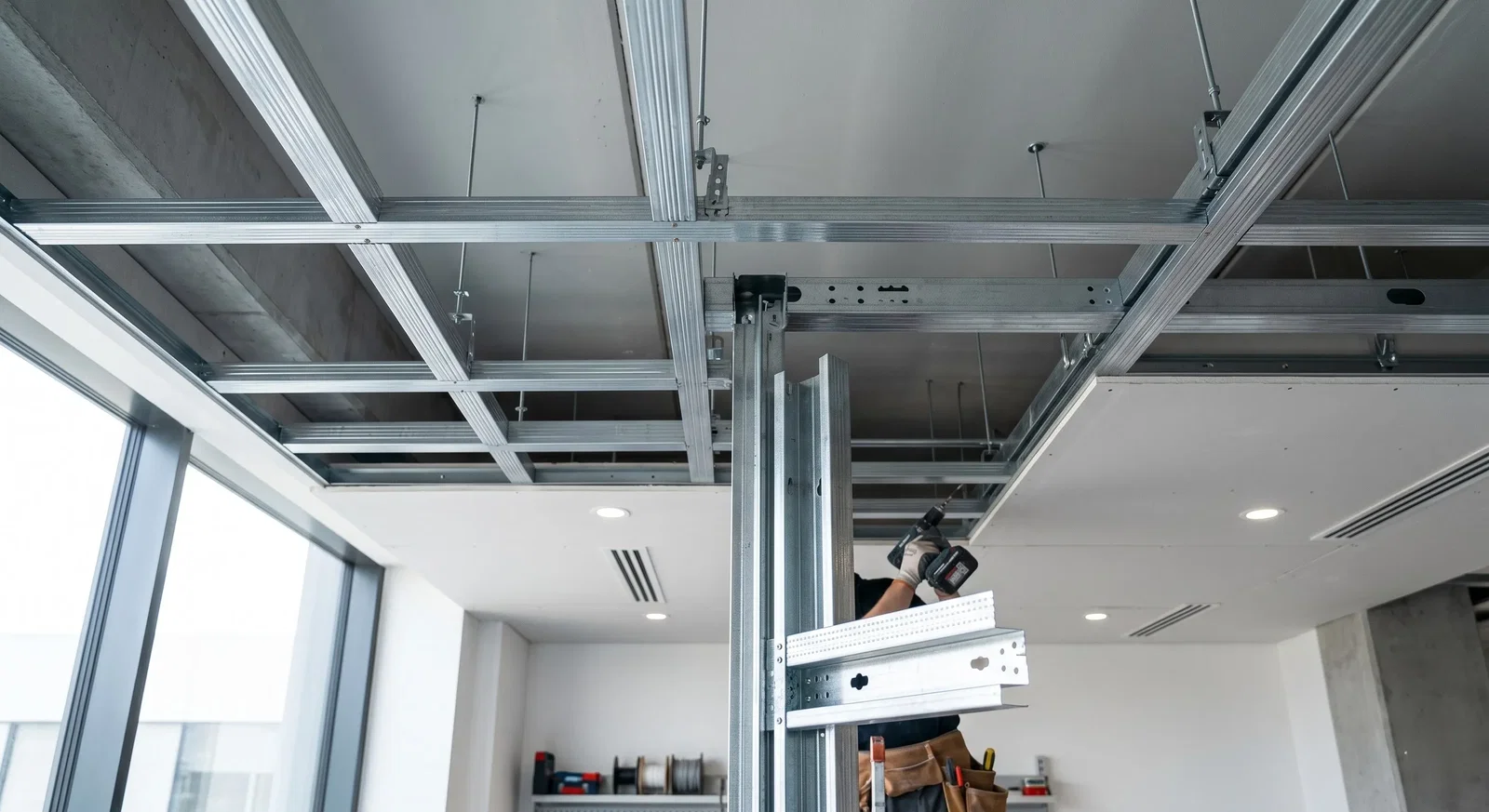
Suspended Ceiling Systems and Load-Bearing Profile Solutions in Modern Architecture.
The Aesthetic and Functional Evolution of Suspended Ceiling Systems in Modern Architecture
As of 2026, modern architectural understanding attributes great strategic importance to ceilings, often referred to as the "fifth facade," in spatial design. The monotonous ceilings of the past, used solely to hide installations, have been replaced by suspended ceiling systems that offer aesthetic depth and high performance. At HC Drywall Profile, we understand that the load-bearing skeleton—the most critical component of this transformation—is the fundamental element determining the lifespan and visual quality of a structure. Modern suspended ceilings are complex engineering solutions that define the volume of a space while simultaneously providing acoustic comfort, lighting integration, and fire resistance. The success of these systems lies not just in the gypsum boards visible on the surface, but in the high-quality profile solutions that remain unseen while carrying the entire load.
The Role of Load-Bearing Profile Systems in Static Safety and Structural Integrity
The safety of a suspended ceiling system is directly related to how dead loads and dynamic forces (airflow, vibration, maintenance loads) are transferred to the main structure. HC Drywall Profile load-bearing systems are manufactured from cold-formed galvanized steel, offering high tensile and flexural strength. The precision of the connections between the main carrier (main channel) and the cross carrier (ceiling C profile) prevents the ceiling from sagging or undulating over time. According to our engineering calculations, a skeleton configured with correct spacing safely carries heavy lighting fixtures or ventilation grilles. The structural integrity of the carrier profiles also determines the seismic behavior of the ceiling during an earthquake, acting as the most important barrier to protect life safety.
Functional Geometry and Assembly Compatibility of Ceiling C and Ceiling U Profiles
Ceiling C and Ceiling U profiles, the two cornerstones of suspended ceiling applications, possess complementary geometries. While the Ceiling U profile serves as the guide element that determines the level of the ceiling by running along the walls, the Ceiling C profile forms the primary surface that carries the main load and to which the gypsum boards are screwed. Profiles coming off the HC Drywall Profile production line are manufactured with tolerances that ensure perfect harmony. Ribs on the edges of the profiles increase metal rigidity, preventing twisting during assembly. This geometric precision speeds up the installation team's work while minimizing the risk of cracking at the gypsum board joints, resulting in a smooth and monolithic ceiling surface.
The Impact of Galvanized Coating Quality on Corrosion Resistance and Longevity
Suspended ceiling systems are often located directly beneath ventilation ducts and installation gaps where humidity can be high. This exposes metal profiles to the risk of corrosion. HC Drywall Profile provides superior protection against rust thanks to the high-micron galvanized coating used in its products. The rusting of profiles used in humid environments (kitchens, bathrooms, or semi-open areas) is not just a visual issue but a serious risk factor that can result in the loss of load-bearing capacity. Galvanized steel skeletons manufactured according to 2026 standards maintain their form throughout the building's life, offering a long-term investment advantage that radically reduces maintenance and repair costs.
Precise Level Adjustment and Flexibility with Hanger Rods and Bracket Systems
How much a suspended ceiling hangs from the main slab depends on the quality and adjustability of the hanging apparatus. Brackets, hanger rods, and spring clips are critical intermediate elements that connect the HC Drywall Profile skeleton to the main structure. In modern architecture, adjusting ceiling levels with millimetric precision is indispensable for recessed lighting applications and tiered ceiling designs. Adjustable suspension systems equalize the ceiling level at every point while allowing a certain degree of flexibility against building movements. This flexibility prevents stresses caused by wind loads or ground settlement, especially in high-rise buildings, from reflecting onto the ceiling surface and causing cracks.
Contribution of Profile Placement to Sound Insulation in Acoustic Ceiling Solutions
In spaces where acoustic performance is paramount, such as offices, conference halls, and cinemas, the sound absorption and reflection balance of the suspended ceiling is vital. The vibration of insulation materials and gypsum boards placed between the profile skeleton and the main slab is controlled by the design of the carrier system. In HC Drywall Profile acoustic solutions, profile spacing and hanging points are planned to minimize resonance. The firm grip of the metal profile on the board helps trap sound waves in the gap behind the board (plenum area) and shortens reverberation time. A correctly configured profile skeleton, combined with perforated acoustic gypsum boards, transforms into an invisible acoustic regulator that elevates the sound quality of the space to the highest level.
Load-Bearing T-Profile Technology in Modular Suspended Ceiling Systems
In grid or modular suspended ceiling systems, T-carrier profiles are generally used instead of fixed gypsum boards. These profile systems, known as T24 or T15, allow the ceiling to be demountable and provide easy access to installations. T-profile systems produced by HC Drywall Profile offer a decorative appearance with white or various color options, while providing an error-free connection thanks to their locking mechanisms. These systems are the most practical solution for meeting the requirement of accessing above-ceiling installations, especially in commercial areas, hospitals, and office buildings. The perfect paint quality on the visible surface of the profile completes the aesthetic integrity of the ceiling while adding industrial elegance.
Profile Shaping Flexibility in Light Coves and Hidden Lighting Details
Hidden light coves, one of the most popular elements of modern ceiling design, require complex profile frameworks. L and U turns, stepped ceiling structures, and circular forms are only possible with high-quality profiles that offer flexible application possibilities. HC Drywall Profile, with its easily cut and screwable structure, allows architects to bring the most creative ceiling forms to life. Additional profile supports used in light cove details are statically reinforced to meet the weight of the lighting elements. In this way, sharp-edged or soft-transition ceiling designs that allow light beams to break on a smooth surface can be safely implemented.
Critical Importance of Profile Cross-Sections in Fire-Rated Ceiling Systems
Fire safety regulations require suspended ceilings to withstand fire for a specific duration (such as F30, F60, F90). Metal profiles exposed to high heat during a fire tend to expand; if this expansion is not managed correctly, the ceiling system can collapse rapidly. HC Drywall Profile fire-rated systems are designed with expansion joints and appropriate gauge thicknesses to absorb expansion under heat. The integrity established by the profile system with fire-resistant gypsum boards (red boards) delays the passage of flames and smoke to upper floors or installation gaps, gaining critical time for the evacuation of the building.
Ergonomic Profile Design Providing Site Efficiency and Ease of Application
On construction sites, time is money. The easier the transport, cutting, and assembly of profiles, the shorter the project completion time. HC Drywall Profile increases site efficiency with ergonomic profile structures developed by taking installers' opinions into account. The dimpled texture on the profile surface prevents the screw from sliding, ensuring fast assembly and reducing labor errors. Thanks to their lightweight yet durable structure, profiles can be easily carried to high floors, reducing vertical logistics costs. Ease of application contributes not only to speed but also to occupational safety by reducing the physical fatigue of the installation team.
Profile Engineering in HVAC and Ventilation Integration
Suspended ceilings house ventilation ducts, which are the lungs of modern buildings. To prevent large-section ducts, fan coil units, and diffusers from clashing with the profile skeleton, profile planning should be done through 3D modeling (BIM). HC Drywall Profile framework systems offer a flexible configuration that allows for installation passages. Optimizing profile spacing according to installation loads prevents sagging that may occur at specific points of the ceiling. Additional reinforcement profiles made around grilles and diffusers prevent mechanical vibrations from causing cracks in the ceiling surface, maintaining the acoustic silence of the system.
Sustainable Architecture and Use of Recyclable Profiles
In 2026, the concept of "Green Building" has become one of the most decisive criteria in material selection. Steel is inherently a 100% recyclable material. HC Drywall Profile serves a sustainable future vision by minimizing the carbon footprint in production processes. The suspended ceiling skeleton of a building that has completed its life can be brought back into the economy with its scrap value. Light steel profile solutions, which have a much lower environmental impact compared to traditional wood or reinforced concrete details, directly contribute to your project receiving international sustainability certifications such as LEED or BREEAM.
Functional Solutions with Installation Access and Access Panels
In fixed gypsum suspended ceilings, access panels are used to reach valves, electrical boxes, or ventilation units above the ceiling. The profile frame where these panels are mounted is a candidate for being the weakest point of the ceiling. HC Drywall Profile eliminates static weakness in these areas with reinforced profile details used around access panels. The perfect alignment of the profile system with the panel frame ensures an invisible finish when the panel is closed, preserving the aesthetic continuity of the ceiling. This intersection of functionality and aesthetics is one of the most important details providing maintenance ease in modern facility management.
HC Drywall Profile Integration in Digital Design and BIM Processes
In the digitalizing construction sector, suspended ceiling designs are now carried out in Building Information Modeling (BIM) environments. Digital libraries of HC Drywall Profile products allow architects and engineers to perform profile quantity estimation, weight analysis, and clash detection during the design phase. This digital integration ensures that material waste on-site is prevented, approaching the "zero waste" goal. A suspended ceiling skeleton planned with accurate digital data guarantees transparent and error-free management of the entire process from the purchasing stage to the assembly stage.
Conclusion: Safe and Aesthetic Ceiling Designs with HC Drywall Profile
Suspended ceiling systems are among the most important building elements carrying the comfort and aesthetics offered by modern architecture. The power behind the visible elegance is the engineering and quality passion of the HC Drywall Profile brand. With the professional solutions we offer in every detail—from static safety to acoustic performance, and from fire resistance to sustainability—we transform ceilings into works of art. Regardless of the scale of your project, by choosing the right load-bearing profile, you build not just a ceiling, but a safe and long-lasting living space. HC Drywall Profile continues to represent quality at the summit of every structure.