
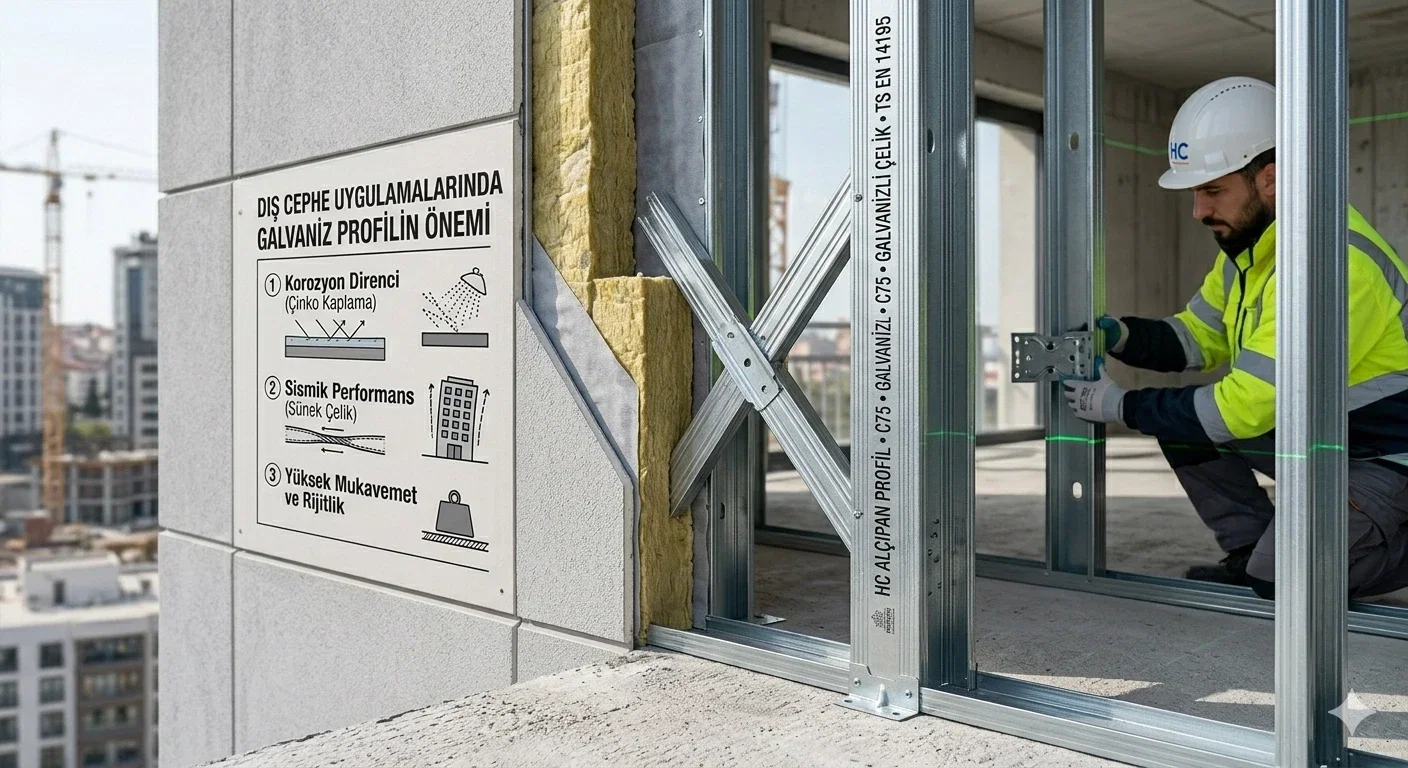
The Importance of Galvanized Profile in Exterior Wall Drywall Applications
The Importance of Galvanized Profiles in Exterior Drywall Applications: Engineering Safety and Duramic Identity
Exterior cladding systems are the most vulnerable components of a structure against atmospheric conditions, yet they are the primary elements that highlight a building's architectural identity. In modern architecture, exterior drywall applications are frequently preferred due to their rapid installation advantages and design flexibility. However, the longevity and safety of these systems depend entirely on the quality of the underlying load-bearing carcass. At HC Drywall Profile, the high-standard galvanized profiles we manufacture form the main backbone of the system against challenging factors such as humidity, temperature fluctuations, and wind loads. Prepared with the right raw materials and precise production techniques, galvanized profiles promise not only an aesthetic exterior but also structural integrity.
The Strongest Shield Against Harsh Exterior Conditions: Galvanized Coating
Profiles used in outdoor applications are under a constant threat of oxidation, unlike those used indoors. Rainwater, air pollution, and humidity degrade the natural structure of the metal, leading to corrosion. The high-micron galvanized coating used in HC Drywall Profile products creates a protective layer on the steel surface, completely cutting off the metal's contact with air and water. Thanks to this coating, the profiles maintain their original form and load-bearing capacity for years without rusting. The galvanization process provides not just surface protection but also structural durability by forming a chemical bond with the steel.
Structural Stability and Strength Balance with HC Drywall Profile
The weight of the drywall boards used on exterior facades and the insulation materials placed upon them create a significant static load on the profile carcass. The strength of the metal used is critical for this load to be carried in a balanced manner and to prevent sagging (deflection) over time. HC Drywall Profile uses S220GD+Z or higher strength steel classes in its production, maximizing fracture resistance while keeping the deflection margin to a minimum. Profile forms optimized through engineering calculations spread the tension created by heavy exterior boards evenly across the surface, eliminating the risk of system collapse.
Non-Stretching Geometry Against Wind Load and Lateral Pressures
In high-rise buildings, exterior facade systems are directly exposed to suction and pressure forces created by the wind. It is essential for the profile carcass to remain rigid against these lateral movements so that the boards do not crack at the joints. The wide-flange and reinforced C-profiles specially designed for exteriors by HC Drywall Profile do not lose their geometric form under wind load. The special serrated texture and fold points on the profile increase rigidity, preventing the system from shaking due to wind effects and consequently preventing screws from loosening.
Extended Building Life and Safety Through Corrosion Resistance
Corrosion that occurs in the exterior carcass of a building may be invisible at first but leads to the weakening of the entire system over time. Rusted profiles lose their screw-holding capacity, which can cause drywall boards to detach and fall. As HC Drywall Profile, we eliminate this risk by using sheets with a zinc coating amount above the standards for exterior applications. Our high-corrosion-resistance profiles reduce maintenance costs throughout the building's life cycle and ensure structural safety by preventing potential work accidents.
Controlling Thermal Expansion and Linear Elongation Factors
Exterior facades are directly exposed to sunlight throughout the day, experiencing significant temperature changes. Thermal expansion, an inherent property of metal, leads to buckling and ripples on the facade if not correctly calculated. HC Drywall Profile products have a homogeneous structure that minimizes thermal stresses. Our profiles, which work in harmony with the recommended dilatation gaps during application, spread the linear expansion reaction across the entire system, preventing local deformations. This ensures the preservation of the smooth and aesthetic appearance of the facade.
Flange Structure Providing Precise Cutting and Ease of Installation
Rapid and error-free application in a construction site environment is essential for the success of a project. HC Drywall Profile ensures that every product coming off the production line has millimetric precision. The edge curves and smooth surface structure of our profiles protect the hands of installation teams while allowing for neater cutting operations. The wide-flange structure, designed to allow boards to sit perfectly in the center of the profile in exterior systems, reduces the margin of error in screw operations and elevates the quality of workmanship.
Non-Combustible Metal Skeleton Contributing to Fire Resistance
Fire resistance, one of the greatest advantages of drywall systems, must be supported by the correct profile selection. Galvanized steel is naturally a non-combustible material and does not ignite even at high temperatures. HC Drywall Profile prevents the system from collapsing immediately by maintaining its load-bearing capacity for a certain period during a fire. Our profiles, which provide a perfect fit with special fire-rated drywall boards used to stop the spread of fire on exteriors, play a critical role in the building's fire safety scenarios.
The Effect of Zinc Coating Quality on Screw-Holding Strength
In exterior applications, screws are the only connection point between the board and the profile. If the galvanized layer on the profile is of poor quality or too thin, this layer is stripped away during screwing, and the exposed metal begins to oxidize rapidly. The tightly-textured galvanized coating of HC Drywall Profile does not deform during the screwing process and grips the screw threads tightly, preventing loosening over time. This is the most important technical detail that ensures facade boards remain stable, especially under vibratory loads created by the wind.
High-Performance Alloys in Humid and Saline Environments
Projects by the seaside or in extremely humid regions are the toughest testing grounds for galvanized profiles. Salt particles in the air accelerate corrosion on the metal. HC Drywall Profile offers higher-weight zinc coating options for these types of special locations, expanding the durability limits of the metal. Our products, which pass salt spray tests successfully, can be used safely in a wide range of projects from luxury residences on coastlines to hotel projects.
Flexible Connection Possibilities for Acoustic Performance and Sound Insulation
Exterior facade systems must keep not only rain but also outside noise away from the building. The design of the galvanized profile carcass can be configured to minimize sound bridges. The various profile widths and sheet thicknesses offered by HC Drywall Profile fully comply with the insulation details recommended by acoustic consultants. When the flexible structure of the profiles is combined with mineral wool placed in the profile gaps, the transmission of outdoor sounds to the interior is significantly reduced.
Metal Profiles in Terms of Economic Life and Sustainability
Compared to wood or other alternative carrier systems, galvanized profiles have a much longer economic life. They do not rot, become infested with insects, or lose their form over time. As HC Drywall Profile, we support sustainable construction techniques by using recyclable steel in our production. An exterior facade built with a durable profile system does not require renovation for decades, providing significant economic gain to the property owner in the long run.
Certified Production and Compliance with International Standards
It is a legal requirement for every material used in the construction sector to have certain quality certificates. HC Drywall Profile ensures that audit processes in your projects pass smoothly by producing in accordance with TSE and CE standards. Every detail, from the sheet metal thickness of the galvanized profiles to be used on the exterior to the amount of zinc coating, is tested in a laboratory environment. The technical data sheets we provide to our customers contain reliable values that engineers can use in their static calculations.
Geometric Perfection Minimizing Installation Errors
Profiles with curves or form defects lead to alignment issues and unsightly surface errors on the exterior facade. The state-of-the-art roll-forming machines of HC Drywall Profile ensure that every profile is produced on a smooth axis and without burrs. This geometric accuracy ensures perfect interlocking at the transition points of the profiles and helps the facade plane to be smooth.
Prevention of Thermal Bridges on the Exterior and the Profile Contribution
Energy efficiency is one of the most important priorities of modern buildings. In exterior drywall systems, metal profiles have the potential to create thermal bridges if not combined with correct insulation details. HC Drywall Profile supports the continuity of the thermal insulation layer by offering the most suitable surface areas for the installation of insulation boards. The rigid structure offered by our profiles ensures that insulation materials are pressed tightly against the profile and minimizes air gaps, making a positive contribution to the building's energy identity certificate.
Project-Based Length and Thickness Solutions with HC Drywall Profile
Every project has its own unique architectural details and heights. Standard length profiles can sometimes lead to excessive waste on-site or an increase in the number of joints. HC Drywall Profile can produce custom lengths specifically for the project according to customer demands. This flexibility both reduces costs and increases the static strength of the facade thanks to one-piece profiles without joints. Our different sheet metal thickness options provide the most accurate solution for every wind load scenario.
Earthquake Safety and the Advantage of Lightness
In regions with earthquake risks like Turkey, reducing the dead loads on a building is vital. Lightweight exterior facade systems consisting of galvanized profiles and drywall boards instead of heavy reinforced concrete or brick facades improve the building's behavior during an earthquake. The light but durable skeleton structure offered by HC Drywall Profile reduces seismic loads and does not place additional burden on the building's carrier system. Our profile structure, which allows for flexible connection details, helps with energy dissipation during tremors.
Construction Site Management with Logistics and Storage Advantages
Galvanized profiles can be easily stored and transported within the construction site thanks to their compact structures. HC Drywall Profile products are not damaged during transport thanks to special packaging systems and occupy minimum space on-site. For craftsmen working on scaffolding during exterior installation, the lightness and ergonomic design of the profiles are important factors that increase work speed. Thanks to our fast shipping network, you don't have to wait for materials at any stage of your projects.
Aesthetic and Architectural Freedom with HC Drywall Profile
An exterior facade is not just a flat wall; it can sometimes include curved lines or stepped surfaces. The easy-to-process structure of galvanized profiles allows for different forms to be created without limiting the architect's imagination. With the technical support of HC Drywall Profile, the safest carcass solutions can be produced even in challenging exterior facade details. Whether it is a modern business center or a luxury housing project, our profile quality serves as the hidden hero behind the design.
Future Projection Protecting the Value of the Investment
Material savings made on the exterior facade of a structure usually return as major expenses within a few years. Renovating a facade that has deteriorated due to poor quality profile selection costs many times more than the initial cost. Choosing the HC Drywall Profile brand means protecting the value of the structure and looking to the future with confidence. The use of high-quality galvanized profiles in compliance with standards is one of the most concrete indicators that a building has been professionally constructed.
Technical Support and After-Sales Services
HC Drywall Profile is not just a manufacturer but also a solution partner for your projects. Our expert technical team is always by your side regarding which profile should be selected for exterior applications, what the axis spacing should be, and static requirements. We help you manage a professional process even in the most challenging exterior cladding systems with site visits, technical drawing support, and installation guides.
In Conclusion, Why HC Drywall Profile for Exteriors?
Success in exterior facade systems depends on all components working in harmony. The foundation of this harmony is formed by the galvanized profiles, which are the skeleton of the system. HC Drywall Profile is your most reliable partner in your exterior drywall applications with its corrosion resistance, high load-bearing capacity, geometric precision, and wide range of products. You can find all the technical equipment necessary to protect your structures from wind, rain, and time in our products. The robust and aesthetic buildings of the future are rising on the high-quality galvanized skeletons of HC Drywall Profile.