
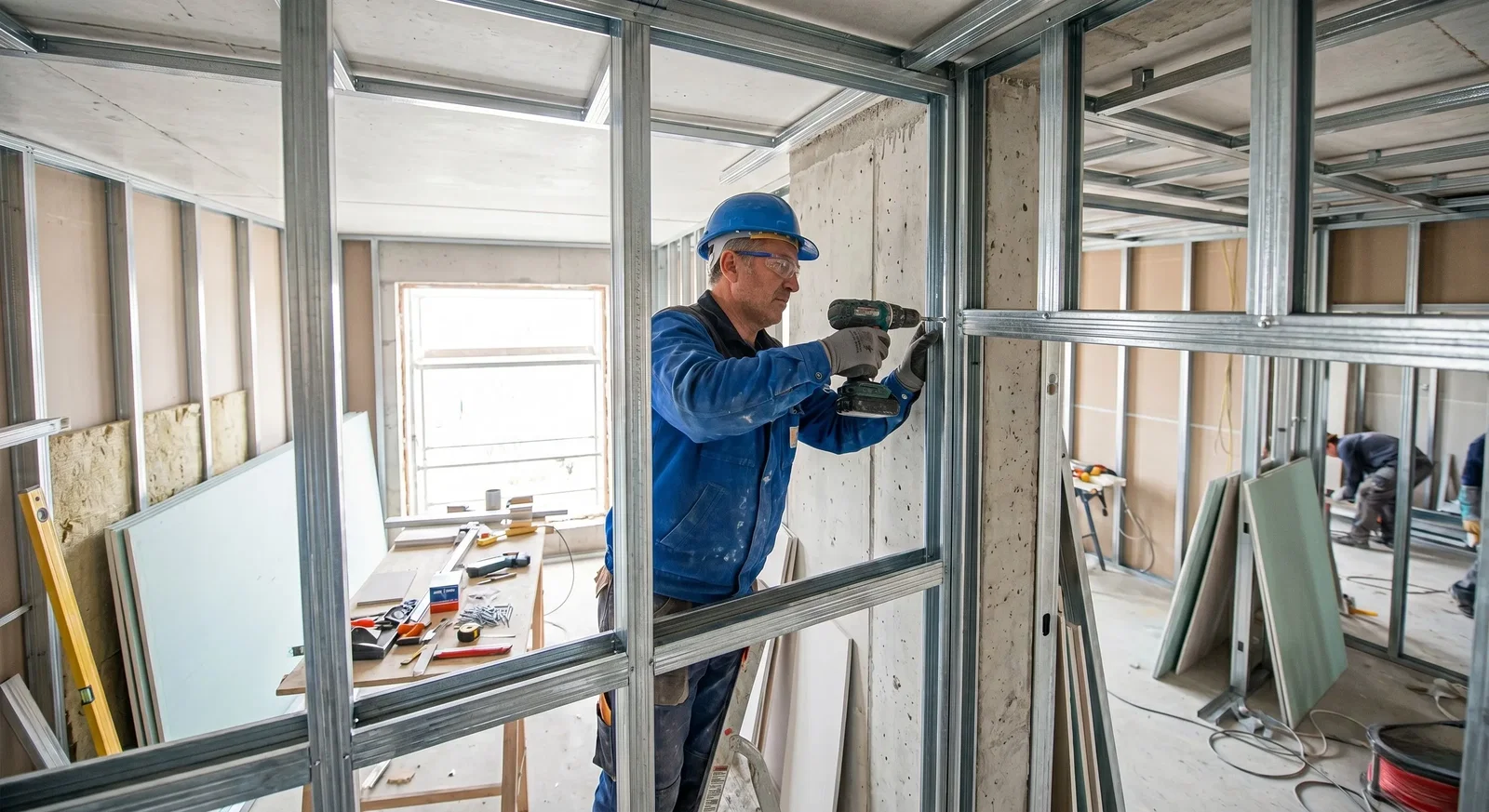
Ways to Minimize Fire in Gypsum Board Profile.
Analysis of the Waste Concept and Economic Losses in Drywall Profile Applications
One of the most critical pillars of cost management in construction projects is controlling material waste. In drywall profile applications, waste is not just a piece of metal thrown into the trash; it also signifies wasted labor, logistics costs, and a heightened carbon footprint. At HC Drywall Profile, we advocate for strategic approaches aimed at reducing waste rates from the industry average of 10-15% to below 3% to increase project profitability. Considering the global fluctuations in raw material prices, protecting every centimeter of a profile can save thousands of dollars in the total project budget. Treating waste as a process to be managed through engineering solutions rather than an unavoidable "fate" is the cornerstone of modern construction management.
The Direct Impact of Accurate Quantity Surveying on Waste Rates at Project Commencement
Inaccurate quantity surveying is the leading source of waste. Incompatibility between the actual dimensions of the application site and the blueprints leads to profiles being either insufficient or ordered in excess. HC Drywall Profile strongly recommends the use of digital measurement tools and Building Information Modeling (BIM) systems during the project planning phase. Bringing a standard 3.00-meter profile to a site where the net wall height is 2.85 meters creates an irreversible loss of 15 centimeters in every single piece. Accounting for door and window openings, column protrusions, and corner turns millimetrically during the survey ensures that the order list matches the actual field needs perfectly.
Approaching Zero Cutting Waste with Custom-Length Profile Production
Standard 3-meter profiles are not suitable for every project, which necessitates intensive cutting on-site. Every cut piece, if it is too short to be added elsewhere, goes directly to scrap. HC Drywall Profile solves this problem fundamentally by offering "custom-length production" for large-scale projects. Profiles produced to the exact dimensions for a hospital project with a floor height of 2.65 meters or an industrial facility at 4.20 meters minimize the use of saws on-site. This approach not only saves material but also eliminates the time spent on cutting and the risk of work accidents, thereby maximizing construction site efficiency.
Implementation of On-Site Piece Joining and Smart Extension Techniques
Although the goal is to use every profile in its entirety, evaluating short pieces that remain after cutting requires a professional approach. Special connection apparatus or interlocking techniques used at the joints of "U" and "C" profiles prevent short pieces from becoming waste. The joining methods specified in the HC Drywall Profile application manuals allow for the recovery of waste into the economy without compromising the static strength of the system. Strategically using leftover pieces from main lines, especially in areas such as over-door gaps or short partitions, is one of the most effective field operations for driving down waste rates.
Preference for Modular Dimensions During the Design Phase
Choosing dimensions compatible with drywall sheets and profile standards during the architectural design phase is a vision that prevents waste from the very start. For instance, while a standard drywall sheet width is 120 cm, planning the axis spacing of partition walls as 40 cm or 60 cm ensures that the profiles work in full harmony with the sheets. HC Drywall Profile engineers collaborate with designers to optimize static calculations according to these standard axes. Insisting on non-standard dimensions causes cutting at every junction for both the sheet and the profile, resulting in a massive pile of waste. Modular design is the key to low-cost, high-quality application.
The Invisible Role of Material Storage and Stacking Conditions on Waste
Waste is not only created by cutting; products damaged due to incorrect storage are also waste items. Profiles left under the rain at the construction site, subjected to heavy loads, or left in the mud can suffer from corrosion or structural deformities. A profile that is bent or has poor surface quality will cause leveling errors during application, making it undesirable for craftsmen to use. HC Drywall Profile products must be stacked on a level surface at the site, preferably in a closed and dry area, and separated by type. Every profile discarded because it was damaged doubles the operational cost by requiring the restart of logistics and procurement processes.
Qualified Workmanship and Educating Craftsmen on Waste Awareness
No matter how advanced technical possibilities are, the fate of the material lies in the hands of the craftsman working in the field. Thoughtless cuts and profiles used extravagantly with the mindset of "there is plenty of material anyway" are the most basic causes of waste. HC Drywall Profile teaches how to cut profiles most efficiently and how to plan for leftover pieces during training sessions organized for application teams. A craftsman thinking, "Where can I use the remainder of this piece?" before making a cut directly impacts project profitability. Motivating field teams through incentive systems and waste tracking applications is essential for sustainable site management.
Popularizing the Use of Profile Cutting Optimization Software
"Cutting optimization software" used in industrial manufacturing has now begun to appear on construction sites. When you enter your list of varying length requirements into the system, the software tells you which pieces to cut from which standard lengths to yield the minimum waste. At HC Drywall Profile, we support the use of such algorithmic solutions in complex projects. These programs find combinations that the human brain cannot calculate in seconds, mathematically minimizing profile loss. A cutting plan blended with technology eliminates the margin for error.
Reconstruction Costs Arising from Incorrect Profile Type Selection
Sometimes waste appears in the form of dismantling and rebuilding the entire system due to the use of the wrong product. Using standard galvanized profiles in a humid area, only for the system to deform quickly due to corrosion, means all the material goes to the trash. Specialized solutions within the HC Drywall Profile range (high-galvanized for green areas, special coated profiles for exteriors, etc.) prevent "premature waste" by extending the life of the project. Choosing the right profile for the right place protects not only today's budget but also your future maintenance and repair budget.
Preventing Logistics Errors and Damages During Shipment
Waste occurring during the process from the factory to the site is also included in the waste calculation. Poor packaging, careless loading, or products deforming by rubbing against each other during transport create a material stock that is "unusable" upon arrival. HC Drywall Profile maintains packaging standards at the highest level to ensure products are unaffected by vibrations and external factors. A profile damaged during transport means both lost time and compensation costs. Secure shipment is the first step of the fight against waste at the factory.
Material Protection During On-Site Handling and Horizontal Logistics
Carelessness during the distribution of materials to floors in large buildings causes the corners of profiles to be crushed or their lengths to be bent. Incorrect lifts with cranes or forced handling in narrow corridors ruin the form of the material. Our recommendation as HC Drywall Profile is to transport materials as close as possible to the application point without opening the original packages. Every time a profile changes hands on-site, it carries a risk of damage. Minimum movement means minimum damage and therefore minimum waste.
Including Leftover Pieces in the Recycling Process
Small metal pieces that inevitably emerge despite all precautions should never be seen as "trash." Steel is a 100% recyclable material. In accordance with sustainability principles, HC Drywall Profile encourages the separation of metal waste on construction sites and its delivery to licensed recycling facilities. Recovering pieces set aside as waste back into the economy as raw material reduces the environmental impact of the project and contributes to the corporate image. Waste management is the most responsible and ethical closing stage of the fight against waste.
Real-Time Monitoring of Waste Rates with Digital Tracking Systems
2026 construction technologies allow for the real-time monitoring of material flow at the site. With barcode or RFID systems, it is possible to track how much profile each floor consumes and how much waste it produces. HC Drywall Profile enables the establishment of a transparent progress billing process and audit mechanism through the integration of such data-driven systems. If the waste rate is 5% in one block while it is 15% in another, this points to an error in workmanship or surveying and provides a chance for rapid intervention. Data is the greatest enemy of extravagance.
Impact of Seismic and Static Details on Waste and Correct Detail Solutions
Seismic profiles and detail solutions used in projects within earthquake zones are more complex than standard applications. Application errors made in these details lead to incorrect cutting of material and jeopardize the safety of the system. HC Drywall Profile technical drawings and application details end waste resulting from trial and error by showing installers the shortest and safest path. Engineering-approved details use material efficiently while guaranteeing seismic safety.
Innovative Use of Packaging and Strapping Apparatus
Even the steel straps or pallet blocks used in packaging products create pollution and waste on-site if not managed correctly. HC Drywall Profile develops innovative packaging methods that provide maximum protection with minimum packaging waste. Furthermore, it works on circular economy models such as collecting shipping pallets or using them as temporary support equipment on-site. Evaluating each component functionally serves the "zero waste" vision.
Conclusion: Reducing Waste is an Engineering Necessity, Not a Choice
Minimizing waste in drywall profiles is a holistic process where accurate surveying, custom-length production, qualified labor, and technological tracking converge. As HC Drywall Profile, we don't just manufacture profiles; we offer a partnership to ensure these profiles come to life in your project in the most efficient, economical, and environmentally friendly way. Every step taken to reduce waste rates directly increases your project's profitability while serving the protection of our natural resources. In the construction world of the future, those who manage the product most efficiently—not just those who produce quality—will endure. HC Drywall Profile is always by your side on your journey of quality and efficiency.