
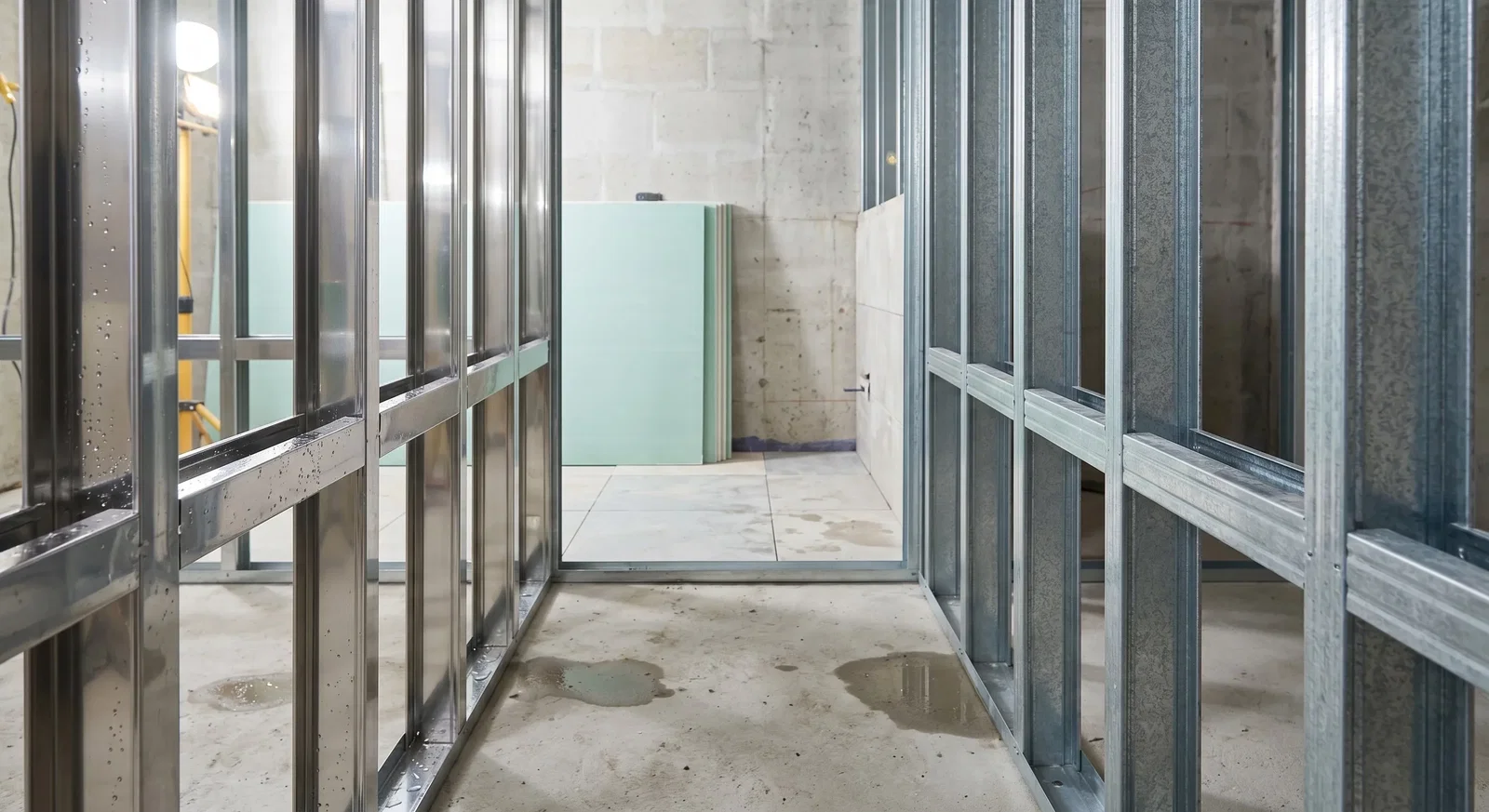
Which should be preferred for stainless steel and galvanized profiles in wet volumes?
The Critical Role of Metal Selection in Determining the Structural Life of Wet Areas
Spaces such as bathrooms, kitchens, Turkish baths (hammams), and swimming pools are defined as the "wet areas" of a structure. Every building material used in these zones is subjected to constant humidity, steam, and direct water contact. The carrier profile skeleton, hidden behind the drywall systems, is the component most affected by these harsh conditions. Choosing the wrong metal leads to the onset of corrosion over time, loosening of screws, and the risk of systemic collapse. At HC Drywall Profile, to ensure you make the right decision for your projects, we deeply analyze the technical differences, service lives, and cost-performance balances between stainless steel and high-galvanized coated profiles. A mistake made in this metal selection—the heart of the structure—will open the door to much more costly renovations in the future.
Chemical Structure of Stainless Steel Profiles and Absolute Resistance to Corrosion
Stainless steel creates a natural passive layer on its surface thanks to its high chromium and nickel content. This layer acts as an invisible shield that protects the metal from external factors when it comes into contact with oxygen, preventing rust from penetrating into the depths of the metal. In wet areas, the use of stainless steel is the safest harbor in environments where metal is in direct contact with water or where chemical vapors (such as pool disinfectants) are intense. When evaluated within the framework of HC Drywall Profile standards, stainless steel profiles can remain standing for decades without showing any structural degradation. However, this absolute resistance brings with it a high raw material cost and processing difficulty.
Protection Mechanism of Galvanized Profiles and the Importance of $gr/m^2$ Values
Galvanized profiles are obtained by dipping carbon steel into a molten zinc bath or through electrolysis. The protection principle here is the oxidation of zinc as a "sacrificial anode" instead of the steel. The amount of zinc coating, namely the $gr/m^2$ value, is the most important variable determining the life of the profile. While a standard galvanized profile may be sufficient for indoor areas, it is essential to choose HC Drywall Profile products with high coating values above TSE standards for wet areas. A thick zinc layer delays moisture from reaching the steel core, preserving the structural integrity of the profile for a long time.
Physical Pressure of Humidity and Temperature Fluctuations on Profiles in Wet Areas
Not only water contact but also sudden temperature changes affect profile performance. Especially in high-temperature wet areas like Turkish baths and saunas, the thermal expansion coefficient of the metal gains importance. Stainless steel tends to maintain its form better than galvanized steel during such extreme thermal cycles. HC Drywall Profile engineers calculate the micro-level movements of metal in hot and humid environments to develop system solutions that prevent expansion-related cracks. In wet areas, it is not enough for the profile to simply resist water; it must also maintain dimensional stability under constantly changing ambient conditions.
Economic Comparison: Initial Investment Cost vs. Total Cost of Ownership
The unit price of stainless steel profiles is considerably higher compared to galvanized profiles. This makes the use of galvanized steel attractive for budget-oriented projects. However, the situation may change when viewed through the window of "total cost of ownership." If low-coated galvanized steel is preferred in an extremely corrosive area like a swimming pool or an industrial kitchen, the entire system might need to be renewed within 3-5 years. At HC Drywall Profile, our recommendation is to use high-galvanized coated profiles in standard wet areas (like residential bathrooms) and stainless steel solutions in extreme conditions. The right choice in the right place is the most economical one in the long run.
Ease of Installation and the Impact of Workmanship Errors on Corrosion
Galvanized profiles are materials that are easier to cut and screw. However, the exposure of the steel core at cutting points creates weak spots where corrosion can begin. Stainless steel profiles are harder to process due to their stiffness, but every cut point retains its stainless property. In the high-quality galvanized profiles within the HC Drywall Profile product range, the cathodic protection effect of zinc kicks in at the cutting points to minimize rusting. Nevertheless, it is a vital rule to ensure that the screws used during installation are in the same metal class as the profile to prevent galvanic corrosion.
Hygiene Standards and Behavior of Metal Surfaces Against Bacterial Growth
Wet areas are the zones where bacteria breed most easily. Stainless steel, thanks to its non-porous structure, does not harbor microorganisms and can be easily cleaned. In areas such as food production facilities or hospital sterilization rooms, even the profile behind the drywall is expected to support hygiene standards. While HC Drywall Profile recommends the stainless steel series for such sensitive areas, it ensures that the quality of the insulation layers applied over galvanized profiles in standard wet areas can be relied upon. A smooth and non-oxidized metal surface indirectly increases the overall hygiene quality of the structure.
Combating the Effects of Chlorine and Salt in Pool and Seaside Projects
Chloride ions are the greatest enemy of galvanized coatings. Chlorinated water evaporating from pools or salty humidity at the seaside can consume the zinc layer in a very short time. In such special projects, the use of galvanized profiles can be risky even at the highest $gr/m^2$ values. HC Drywall Profile considers the use of 316-grade stainless steel profiles in wet area projects at sea level or around pools as an engineering necessity. In these locations where salty air "melts" metal, only the most durable alloys can offer a long-term guarantee.
Fire Safety and Metal Performance in Wet Areas
Fire safety is essential for every structure. Stainless steel is a step ahead of galvanized steel in terms of melting point and load-bearing capacity under high heat. In a fire scenario that may occur in wet areas, a profile skeleton weakened by the effect of high humidity may collapse faster. HC Drywall Profile provides certifications compliant with fire regulations in both metal groups. However, the fact that stainless steel maintains its rigidity longer at extreme temperatures increases the time required for fire insulation systems (such as fire-resistant drywalls) to perform their duties.
Sound Insulation and the Contribution of Metal Density to Acoustic Comfort
Wet areas are usually covered with sound-reflective surfaces like tiles and ceramics, making sound insulation more difficult in these zones. The density of the metal profile affects the sound transmission loss of the partition wall. The specific weight and molecular structure of stainless steel profiles may exhibit a different performance compared to galvanized steel in blocking the transmission of low-frequency sounds. In HC Drywall Profile system designs, water and speech sounds that could pass from wet areas to adjacent rooms are minimized by using acoustic tapes and correct insulation fills for both profile types.
Aesthetics and Functionality: The Hidden Power Beneath the Drywall
Often, the quality of the drywall profile is neglected with the logic of "out of sight, out of mind." However, a wrong choice made in wet areas reveals itself after a few years with rust stains leaking through ceramics or the cracking of joints. HC Drywall Profile branded stainless or high-galvanized products are the hidden heroes that preserve the lifespan of the surface aesthetics. When the stability of the metal is compromised, even the most expensive ceramic will deform along with the skeleton it sits on. Therefore, profile selection is not just an engineering decision, but an investment in the future of the decoration.
Sustainability and Recycling: Profile Selection in Green Buildings
In modern architecture, the environmental impact of buildings is also measured. Both stainless steel and galvanized steel are 100% recyclable materials. However, the fact that the service life of stainless steel is almost limitless reduces the material replacement cycle, thereby lowering the carbon footprint. HC Drywall Profile exhibits an eco-friendly approach in both metal types by considering energy efficiency in production processes. Establishing a very long-lasting system in wet areas ensures less consumption of natural resources and contributes positively to the sustainability certification of the building (LEED, BREEAM, etc.).
Screw and Accessory Compatibility: Managing the Risk of Galvanic Corrosion
When two different metals (for example, a galvanized profile and a stainless screw) come together and a humid environment is formed, "galvanic corrosion" begins. In this case, the weaker metal erodes rapidly. Our biggest warning to HC Drywall Profile users is that whatever metal the profile is selected from, the suspended ceiling rods, screws, and connection apparatus should also be selected from the same metal or from coatings that will not interact with each other. A large portion of failures in wet areas stems not from the profile itself, but from these small but critical accessory incompatibilities.
Application Details: Corner Profiles and Wet Area Finishes
In wet areas, wall corners are where water accumulates the most. In these spots, not only carrier profiles but also corner profiles are of great importance. Stainless corner profiles in the HC Drywall Profile product range provide the ultimate protection against impacts and moisture at the extreme points. In galvanized options, the coating must not have cracked at the bending points. When quality workmanship is combined with the correct profile selection, problems such as the famous "smell of dampness" and "moisture bleeding" in wet areas become a thing of the past.
Quality Control and Certification of Compliance with Standards
Every profile produced at HC Drywall Profile facilities undergoes rigorous testing, regardless of the metal type. Salt Spray Tests allow the corrosion resistance of the metal to be measured in an accelerated laboratory environment. Our high-galvanized products and stainless series recommended for wet areas fully comply with international corrosion classes (C3, C4, C5). The corrosion resistance duration required in the technical specifications of your project is our fundamental guide in product selection.
Conclusion: Which is the Best Decision for Your Wet Area Project?
In summary, stainless steel profiles are ideal for extreme wet area projects where maximum durability, hygiene, and prestige are required, and the budget is secondary. High-galvanized coated HC Drywall Profile products offer an excellent price-performance solution for standard wet areas (residences, offices) with correct application and good waterproofing. When deciding, the location of the building, the humidity load of the environment, and the targeted service life should be evaluated as a whole. We secure the skeleton of your structures by offering the highest quality standards in both solutions. A strong structure begins with a correctly chosen skeleton.