
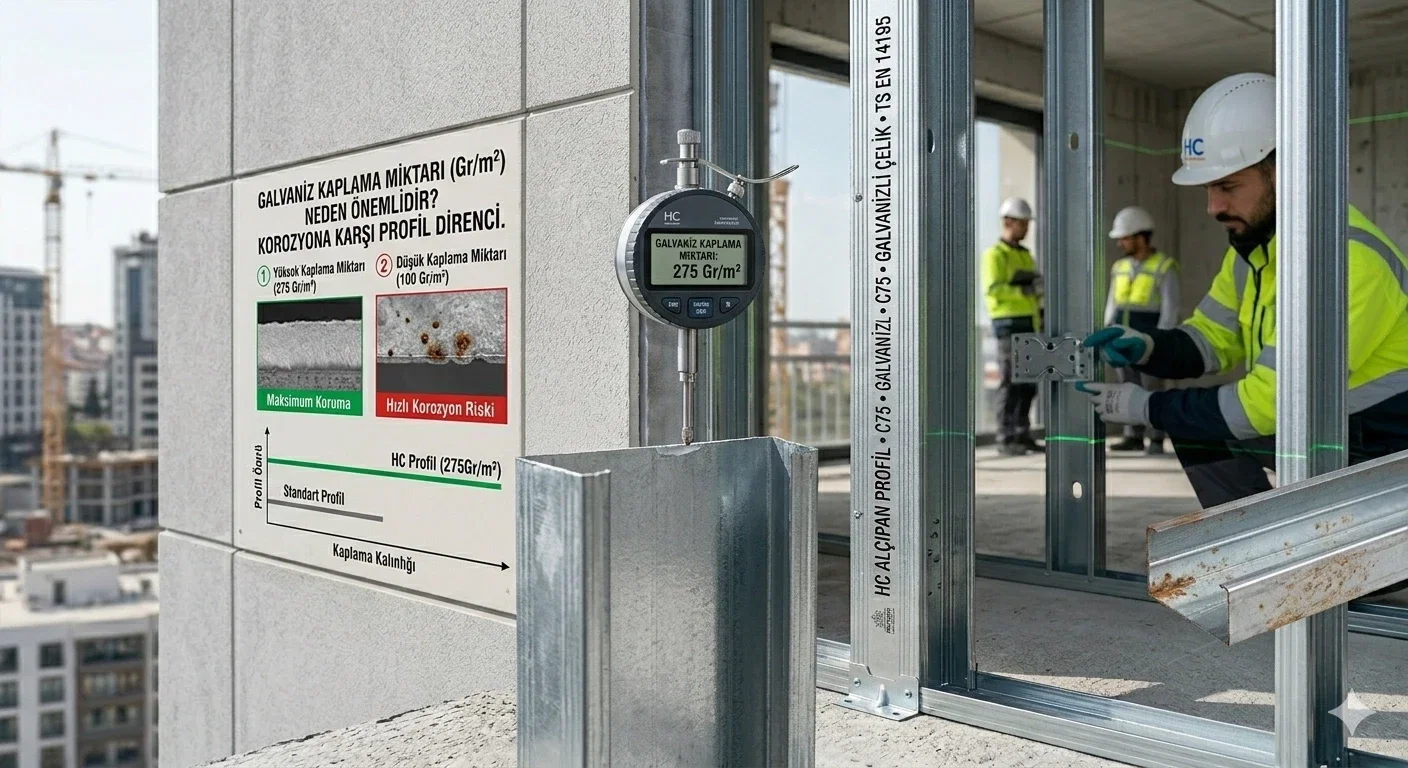
Why is the amount of galvanized coating (g/m²) important? Profile resistance against corrosion.
Why is Galvanized Coating Amount ($gr/m^2$) Crucial? Profile Resistance Against Corrosion
In metallurgical terms, galvanization is the process of coating steel with zinc to protect it from corrosion. The density of this coating is measured by the mass of zinc per square meter of surface area, expressed in the unit $gr/m^2$. At HC Drywall Profile, we identify this coating amount as a critical quality parameter by analyzing the environmental conditions each profile will encounter on our production line. The coating amount is not just a number; it is the thickness of the protective armor that cuts off the metal's contact with the outside world. The higher this value, the longer the "service life" of the steel before it begins to rust.
Chemical Mechanism of the Corrosion Process and Cathodic Protection of Zinc
By nature, steel rapidly oxidizes to form iron oxide—commonly known as rust—when it comes into contact with oxygen and moisture. The galvanized coating acts as a "sacrificial anode" in this scenario. Since zinc is a more reactive metal than iron, corrosive effects attack the zinc layer first. The dense zinc atoms in HC Drywall Profile products react with the environment to form a thin but highly resistant zinc carbonate layer on the surface. This chemical barrier prevents corrosion from reaching the inner steel core. When the coating amount is low, this sacrificial layer is quickly depleted, and the profile begins to lose its structural integrity in a short time.
European Standards and $gr/m^2$ Classifications in Drywall Profiles
Galvanized sheets used in the construction industry are generally classified according to the EN 10346 standard. Codes such as Z100, Z140, or Z275 in these standards represent the total coating amount. Unlike sub-standard products offered under the name "economical" in the market, HC Drywall Profile manufactures in full compliance with technical specifications. While Z100 may be sufficient in indoor areas with low humidity, it is mandatory to increase this amount for exterior facades or wet areas. Correct classification is a vital data source for the static safety of the project.
Direct Impact of Coating Thickness on Screw Holding Strength and Mechanism
Each screw driven into the profile during drywall installation actually punctures the protective galvanized layer. This is where the importance of the coating amount comes into play. In HC Drywall Profile products with a high $gr/m^2$ value, when a screw hole is opened, zinc atoms gather around the hole, exhibiting a "self-healing" property. If the coating amount is insufficient, corrosion starting from the screwing point quickly spreads to the interior of the profile. A thick zinc layer ensures that the screw locks more tightly into the metal threads and prevents loosening caused by vibration over time.
High Galvanization Requirements in Humid Environments and Coastal Projects
Wet areas such as bathrooms and kitchens, or projects located along the coastline, are the most aggressive environments for metal profiles. Chlorides in the air and constant humidity increase the corrosion rate geometrically. HC Drywall Profile preserves the life of the metal with high-grammage coating options specially developed for such projects. While low-quality profiles show "flaking" within a few years in these environments, profiles with correctly calculated zinc density maintain their strength for decades. This ensures not only the aesthetics of the structure but also the safety of the users.
Linear Relationship Between Metal Fatigue and Corrosion
When a profile under static load undergoes corrosion, its metal cross-sectional area narrows. A reduction in the cross-sectional area means a decrease in the load-bearing capacity of the profile and the deflection margin going out of control. The dense galvanized layer used in the production of HC Drywall Profile protects the static balance of the system by delaying the rusting process that triggers metal fatigue. A metal that begins to rust loses its elasticity and becomes brittle. This is the biggest risk factor paving the way for sudden collapses, especially in suspended ceilings.
Precise Coating Control and Testing Processes in HC Drywall Profile Production
In our brand's quality control laboratories, coating amount tests are performed on samples taken from every production batch. The compliance of the $gr/m^2$ value with standards is inspected using electromagnetic measuring devices and chemical stripping methods. HC Drywall Profile focuses not only on the sheet thickness but also on the zinc distribution at the micro-level on the sheet. A non-homogeneously distributed coating provides protection at one point of the profile while leaving it vulnerable at another; we completely eliminate this risk with our modern production technology.
Reducing Building Maintenance Costs with High Corrosion Resistance Profiles
The construction cost of a structure includes not only the initial investment but also the maintenance expenses required throughout its operational life. Using low-galvanized profiles may seem like a saving in the short term, but in the medium term, it results in high renovation costs due to sagging ceilings and the formation of cracks. HC Drywall Profile minimizes these expenses thanks to its high corrosion resistance. Drywall applications built on a solid skeletal system do not require intervention for decades and help preserve the property value.
Great Danger Created by Rusted Profile Usage in Earthquake Zones
Buildings are expected to flex and oscillate during an earthquake. However, a profile skeleton that has rusted and thinned due to corrosion cannot resist these dynamic loads. HC Drywall Profile regards galvanization quality as a vital safety layer for projects in earthquake zones. A ceiling system with loosened screws or weakened connection points due to corrosion endangers life safety by falling during a tremor, even if the building itself does not collapse.
Contribution of Galvanized Coating to Environmental Sustainability and Recycling
Zinc is a completely recyclable natural resource. Protecting steel profiles with galvanization actually increases the life of the steel by 5 to 10 times, thereby reducing natural resource consumption. At HC Drywall Profile, we embrace sustainable construction principles. A profile with a high coating amount does not lose its economic value even when it is scrapped, as the steel quality inside is preserved. This is an approach that both protects nature and serves the circular economy.
Sheet Thickness or Galvanization Amount? Establishing the Right Balance
Generally, only the "thickness" of the profile is checked at construction sites; however, a profile that is 0.60 mm thick with low coating may have a shorter life than a profile that is 0.50 mm thick with high coating. HC Drywall Profile does not separate these two parameters in engineering solutions. Sheet thickness must be optimized for static strength, while the galvanization amount ($gr/m^2$) must be optimized for environmental durability. When this balance is not established in the skeleton of a building, even the most solid-looking structures are weakened by corrosion eating away from the inside.
White Rust Formation and Prevention Methods in Logistics and Storage
When newly produced galvanized profiles are stacked tightly on top of each other and exposed to moisture during storage, a type of oxidation called "white rust" can develop. This is a defect that causes the zinc layer to deplete rapidly. HC Drywall Profile applies appropriate packaging and storage standards to protect its products from such risks. Although a high coating amount provides an additional margin of resistance against such superficial oxidations, correct storage is always our priority.
Hidden Reason Behind Aesthetic Defects: Profile Corrosion
Brown spots or paint peeling seen on drywall surfaces are often labeled as "moisture." However, in many cases, this is the underlying profile rusting and bleeding through to the surface. You can prevent such aesthetic disasters by using HC Drywall Profile. Our profiles with high $gr/m^2$ rates provide chemical harmony with the gypsum powder inside the drywall and prevent the metal from oxidizing and damaging the decorative surface. A flawless interior design is only possible with a flawless metal infrastructure.
Role of Coating Quality in Fire Safety Scenarios
Drywall systems must maintain their structural integrity for a certain period during a fire. A profile skeleton subjected to corrosion deforms and collapses much faster than solid metal when exposed to high heat. HC Drywall Profile evaluates the galvanized layer not only against moisture but also as a protector that slows down the oxidation rate of the metal. A solid and non-rusted profile keeps the fire insulation boards in place, gaining the golden minutes required for the evacuation of people from the building.
Importance of Specifying $gr/m^2$ in Project Specifications
Architects and engineers writing only "galvanized profile" in their projects leads to uncertainties in application. Using clear expressions like "at least Z140 coating quality" guarantees the quality of the structure. HC Drywall Profile transparently presents all technical values that professionals can use in specifications. This transparency facilitates auditing mechanisms and ensures that the expected performance is achieved at the end of the application.
Long-Lasting and Safe Tomorrows with HC Drywall Profile
In conclusion, the galvanized coating amount is a fundamental requirement of structural engineering rather than a choice. Every single gram of zinc in $gr/m^2$ is another year added to the life of your structure. All products we offer under the HC Drywall Profile brand are a result of this awareness and responsibility. Our profiles, produced with the right raw materials, high coating standards, and precise workmanship, secure not only the present but also the future of your projects. Choosing HC quality for a construction process far from static errors and corrosion risks is the most solid step toward structural safety.